An article about Danah Boyd's SXSW EDU keynote, "What Hath We Wrought?," caught my eye for the use of the phrase "weaponized critical thinking." As someone who has taught critical thinking in many classes and as a course in itself, the idea of "weaponizing" the subject was frightening.
That fear is what Boyd talks about. It comes from a lack of media literacy, fake news, media manipulation and, unfortunately, the democratization of access to media. That access was thought to be a key benefit of "Web 2.0" when we would becomes producers rather than just consumers of web and media content.
I do believe that this led to some rational discourse and more viewpoints getting exposure, but Boyd and others would argue that there was too much democratization. The founding fathers warned of a democracy where mobs could rule. With all the options and possible sources of information, most people gravitate (a word that I think implies this invisible force) to things that align with our own existing positions.
In her talk, Boyd summarized her research into the ways in which social media can often turn the habits of critical thinking against itself. Frightening.
Showing posts with label social media. Show all posts
Showing posts with label social media. Show all posts

What a Photo Posted Online Can Say About You

You're probably tired of stories about privacy, Facebook and social media. But in the midst of all that the past few months, I continue to see lots of my online friends taking quizzes, liking posts and especially uploading photos.
Oh, what's the harm in posting a photo?
Your camera or phone adds a lot of data to a photo file. Especially with your camera's phone (on Flickr and many photo sharing sites, the most popular "camera" is a phone) you are sharing your location, the date and time, the kind of device you used and its device ID and your mobile provider. It will also ping off any nearby Wi-Fi spots or cell towers, so your location is there even if you don't add that to the image post.
Add in facial recognition, which Facebook and Google use on your photos, and features will try to determine who is in that photo. If you tagged anyone or captioned the photo or added a new specific location, you are feeding the database. Thanks, users!
Think about how this data along with knowing who your friends are and their data and where you go with or without them and it builds a very robust picture of you and your world.
Can't this be controlled by us? To a degree, yes, but not totally. Your phone and some cameras will automatically record that data for every shot. You can turn off location services/geotagging in some instances, but I'm not even convinced that the data still isn't there anyway. And if you are automatically backing up your photos to iCloud or Google or somewhere in the cloud, I'm not positive that even your deleted photos are forever gone along with their metadata.
Am I overly paranoid? Can anyone be overly paranoid about privacy these days?
Hello, What Is Your Social Credit Score?

You don't have such a score now, but you may one day. A Social Credit System is a proposed Chinese government initiative to develop a national reputation system. Though it is still being developed, the intent is to assign a "social credit" rating to every citizen. The score would be based on government data regarding their economic and social status.
If it sounds more like a science-fiction horror story of the future, that was what I thought at first. It reminded me of the 2016 episode of the science fiction anthology series Black Mirror which is shown on Netflix.
Reputation systems are programs that allow users to rate each other in online communities in order to build trust through reputation. They already exist on E-commerce websites such as eBay, Amazon.com, and Etsy as well as online advice communities such as Stack Exchange.
Reputation systems represent a significant trend in "decision support for Internet mediated service provisions" such as shopping and advice.
A variation is collaborative filtering which aims to find similarities between users in order to recommend products to customers.
The Social Credit System proposed by the Chinese government is meant to rate every citizen based on government data regarding their economic and social status. If it sounds like a mass surveillance tool using big data analysis technology, that is because that is what it is.
On the surface, it is a way to rate businesses operating in the Chinese market.
Some might call this "surveillance capitalism." That term (introduced by John Bellamy Foster and Robert McChesney) denotes a new genus of capitalism that monetizes data acquired through surveillance.
It was an idea popularized by Shoshana Zuboff who says it emerged due to the "coupling of the vast powers of the digital with the radical indifference and intrinsic narcissism of the financial capitalism and its neoliberal vision that have dominated commerce for at least three decades, especially in the Anglo economies."
It is a new new expression of power she calls "Big Other." In a reference that might sound like the plot for a new novel combining Brave New World and Nineteen Eighty-Four, she feels the concept was first discovered and consolidated at Google, who are to surveillance capitalism what Ford and General Motors were to mass-production and managerial capitalism a century ago.
Facebook and others have since adopted the concept for ways to extract, commodify and control behavior to produce new markets of behavioral prediction and modification.
In that Black Mirror episode ("Nosedive"), people can rate each other from one to five stars for every interaction they have, and the protagonist is someone obsessed with her ratings. When her rating drops, she panics and goes on a campaign to bring her score back up.
A Chinese app called Alipay is already assigning users a three-digit score. "Zhima Credit" rates you from 350-950 based on finances and and other factors.
The Chinese government's "Planning Outline for the Construction of a Social Credit System (2014–2020)" focused on four areas: honesty in government affairs, commercial integrity, societal integrity and judicial credibility. The rating of individual citizens is considered to be "societal integrity." The plans are to have credit scores for all businesses operating in China.
In a news story I heard, it said that you can gain or lose points for how well you separate and recycle your trash. It was unclear how this is monitored - trash collectors, your neighbors, credit police?
Eight companies were picked by the People's Bank of China in 2016 to develop pilots to give citizens credit scores, including the giant Alibaba Ant Financial Services, which operates Sesame Credit. Ant Financial CEO Lucy Peng has said that Zhima Credit “will ensure that the bad people in society don’t have a place to go, while good people can move freely and without obstruction.”
Fear of Missing Out

You were away for a five days of vacationing and you didn't have phone service. It was kind of nice to be disconnected. But now, you're back home and reconnected.
You check your email accounts. Half junk and half things you now need to read and respond to. But what about all the posts you missed on Facebook, Twitter, Instagram and other social networks?
It is difficult to actually scroll through days worth of social media. Leave your Twitter feed unread while you're at work and when you sit down after supper there are hundreds or thousands of missed posts.
If you can just shrug and say "So, I missed some things while I was gone. No big deal," then you have a healthy attitude.
But if you feel like you have to go back and at least glance at what you missed, you may have "fear of missing out" or FoMO.
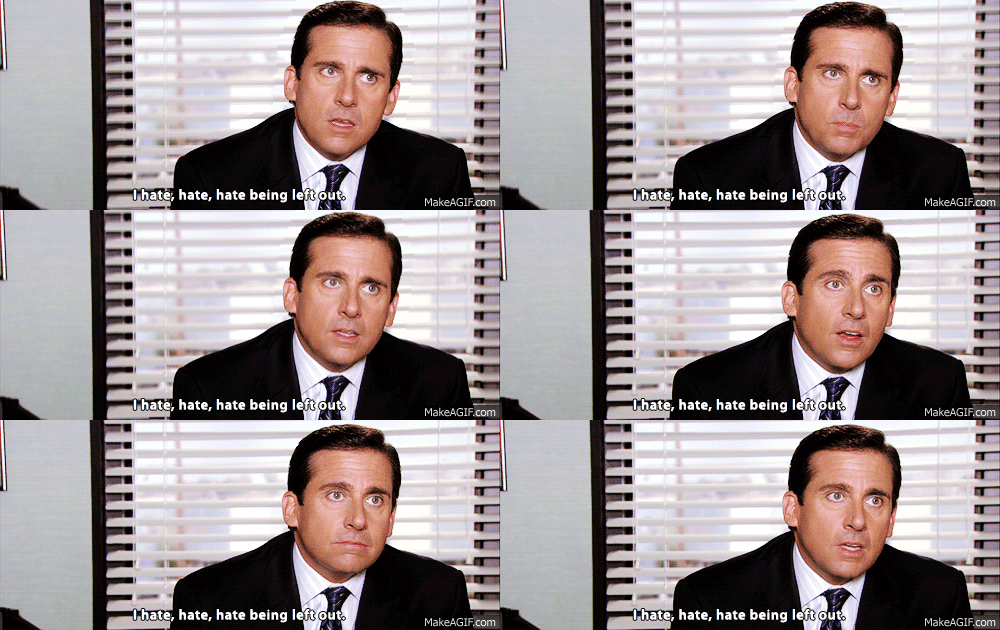
FoMo is real. It is defined as "a pervasive apprehension that others might be having rewarding experiences from which one is absent."
If you suffer from this newly-recognized social angst, your desire to stay continually connected with what others are doing is strong.
Of course, almost all of us don't want to miss out on good things. The crew from your office went out last Friday after work for drinks and had a great time. You were away at a meeting all day and missed it. Do you feel regret?
With FoMo that regret is a compulsive concern. It makes you question decisions on how you spend your time.
"Things could have been so different if I had only..." is a a common FoMo thought.
This didn't start with the Internet. Fifty years ago without the Net or mobile phones people were worried that they might miss out on important things. I have given up subscriptions to print magazines and newspapers because they were piling up unread and I couldn't bear to just recycle them unread for fear that there was some story or article that I would really love. (Somehow I can easily ignore/delete digital issues of those same publications.)
25 years ago, if I went on vacation, I would come home and wonder what I missed. I'd look at the local paper and talk to friends. There usually wasn't much that had happened.
But technology has moved so much social and communicative experiences online, and it moves so fast and with so much content that we just "know" that we have missed a lot.
It is said that social networking services allow us the opportunity to be socially engaged with a reduced "cost of admission." I have more contact and "conversations" with people I went to high school with on Facebook than I ever did when we were in school together. Is that sad or wonderful?
A psychological dependence on staying connected can certainly produce anxiety when you are disconnected. Fear of missing out has become more than a meme. It is something that has a negative influence on people's psychological health and well-being.
Advertisers have known about this for a long time and used it. Campaigns based on "not missing out" and feeling included in the popular or "in" group are classics. I once belonged to the Pepsi Generation and was also a "Pepper."
1979 Commercial for Dr. Pepper soda with David Naughton (An American Werewolf in London)
The cure for all this seems simple: disconnect. But that is no more of a solution than telling anyone with an addiction to just stop giving in to the desire to use.
Step One: Recognize the problem. Disconnect from all media for a weekend. No phones, TV, or news in any form. Go to a desert island of your own making. Then, monitor how you act during the weekend and also how you when you return to the world. Any fear that you missed out on some good things?
MORE
http://time.com/4358140/overcome-fomo/
https://www.sciencedaily.com/releases/2016/03/160330135623.htm
http://www.huffingtonpost.com/quora/how-can-i-let-go-of-my-fe_b_12575496.html
Virtual Book Clubs
Peter is not really a book club type.
Book clubs, where people read a common book and then meet to discuss it, have been around for a very long time. There was a plethora of them in England in the 19th century and I'm sure they existed in almost every reading country. I know of a few in my area that meet at libraries. But I have also been seeing a kind of virtual book club scene developing online.
Remember Oprah's Book Club on her network TV show? It had tremendous book-selling power. her selection could send a book right to the best-seller list. Good for publishers and authors and good if it got more people to read and think about their reading. I thought her club ended with the show, but it still ives online at oprah.com, but when I looked at it it was a bit too busy with ads for Waitress on Broadway and how to self-publish your book, a popup for her magazine, and links to articles on the web about “crepey skin” and “7 foods that cause gray hair” and “9 ways that coconut oil will change your life.” Very commercial and without any book talk.
Other celebrities have taken to suggesting books for us to read. Mark Zuckerberg on Facebook and Emma Thompson Watson on Twitter and Reese Witherspoon on Instagram are all letting us know what to read via social media. Oscar-winner Brie Larson recommended Slade House by David Mitchell to her 240,000 followers at that time. Emma Watson, one from Hogwarts, now a feminist, recommended a non-fiction title, My Life on the Road by Gloria Steinem to her 20.8 million followers on Twitter. I saw that Reese Witherspoon, using Instagram, recommended Opening Belle, a novel by Maureen Sherry.
Is it a "book club" if all you do is suggest something to read? No. Do we trust that celebrities are recommending books they read and really enjoyed or do we suspect that this is just marketing? I'm half and half on that.
I had seen last December that Mark Zuckerberg recommended reading The Beginning of Infinity to his 48.9 million followers, so I borrowed the book from the library. It's not a new book (published in 2011) so I don't think it was a new book promotional kind of suggestion. Subtitled "Explanations that Transform the World," it is a science book for the general public by physicist David Deutsch.
Deutsch looks at the enlightenment of the 18th century as a beginning of an infinite sequence of knowledge creation. He defines knowledge as information that is proven and allows for some real process that is physically possible to be performed. That time that we call "The Enlightenment" provided the conditions for knowledge creation. It disrupted the earlier static societies that stifled creativity and did not encourage free and open debate. It's that a similar time had not previously existed. Earlier we had the Renaissance in Florence and Plato's Academy in Golden age Athens, and things got going, but then they were met with resistance to change.
I thought the book was pretty interesting, but I'll admit that I skipped and skimmed. After all, there was no test or book club I had to answer to later.
Zuckerberg never really promoted it as a book club, although Facebook - or some new online platform of their creation - certainly would have allowed for such a thing to occur. It was his New Year's Resolution for 2015 to read one book every two weeks. he chose books which "emphasize learning about new cultures, beliefs, histories and technologies."

 Actress Reese Witherspoon seems to be a real reader and she has already brought two of her favorite reads — Gillian Flynn’s Gone Girl and Cheryl Strayed’s Wild — to the big screen. (I read both. Disliked the first, really liked the second - true for the books and the movie versions.)
Am I a bit suspect that the books she picks are all part of a clever and long range film marketing strategy? Yes, but I really like Reese the actress, so I accept that this is the plan.
In the works are adaptations of Jessica Knoll’s Luckiest Girl Alive, Garth Callaghan‘s memoir Napkin Notes: Make Lunch Meaningful, Life Will Follow. Read now and the movie will follow.

 Then there is actor James Franco with 5 million followers on Instagram. He, who has all kinds of degrees now in literature, seems to recommend books off the class syllabi. They are good reads and books I would recommend too - like Slaughterhouse Five by Kurt Vonnegut and Something Wicked This Way Comes by Ray Bradbury. And both already have film versions, so I don't see any film crossover deals. Unless he gets a publisher kickback, this seems well-intentioned.
 He has a book club page on GoodReads.com but it just shows some book jackets, so it is a pretty lousy club to belong to if you're looking for discussion. But, that site allows you to discuss any book on GoodReads and leave reviews and recommendations, so it is a site I use and would recommend.
Do you participate in a real-world or virtual book club? Have any recommendations about online book clubs or books? Comment below. But this isn't a book club.
To Retweet or Not To Retweet
I read a post titled "Preserve Peace of Mind on Twitter by Disabling Retweets" and started to wonder how much peace of mind I might preserve by doing this tech tweak of tweets.
I have a few friends who have been trying "no tech days" or "no social media" weekends. I don't do any longterm unplugging unless I'm on vacation and have lost the connection. I do deliberately leave the phone behind sometimes on walk in the woods or dates with my wife. But sometimes I want the phone camera to record things and sometimes I upload those pictures or announce my location or activities.
Retweets (RT) on Twitter (to repost someone else’s tweet to your own followers) and Shares and Likes on Facebook and other social networks are a big part of the social experience.
As the article points out, retweets can promote community and boost the reach of stories (including your own) and point you to new people.
But there are people who seem to retweet a lot more than say anything original. To be kind, I could say that they are helping to filter things of interest for you from the landslide of things out there. But retweeting is also a spammish way to try to gain followers (along with following everybody you can find).
You can disable retweets from a particular account without unfollowing the account and still get their original tweets. Some people do that using a Twitter client (like Tweetbot) and you can do it in Twitter (more details in that article).
But should you?
Shakespeare on Social Media
Benvolio in Shakespeare's Romeo and Juliet, III. i. 50-53 on our use of Twitter, Facebook and other social media sites.
"We talk here in the public haunt of men.Either withdraw unto some private place,And reason coldly of your grievances,Or else depart; here all eyes gaze upon us."
The 10 Most Retweeted Tweets of the Year

Musicians dominated 2010's Most Retweeted Tweets list:
Drizzy Drake (@drakkardnoir) took the #2 spot
Lil Wayne (@liltunechi) came in at #3.
4 is the fascination with Justin Bieber (@justinbieber)
with pop stars Joe Jonas (@joejonas) and Rihanna (@rihanna) made the list at #6 and #9 with their Bieber-related Tweets.
Lady Gaga (@ladygaga) hit #7
and Kanye West (@kanyewest) is #8.
Humor is a key part of the Twitter experience, and the Most Retweeted list reflects the way that people use the service for comedy and parody.
A Tweet from the spoof account @alqaeda clocked in at #5
words of wisdom from @shitmydadsays (which got him a TV show deal) slipped into #10.
Social Media Books
There's a stack of my books on my basement desk that I'm using for the social media course I'm teaching this summer.
Some of these were books I had read, some were recommended - some I own, some I borrowed from the college library.
My students are reading at least one of these based on their own area of interest in social media. The original list of titles was crowdsourced online.
Titles recommended that I didn't get to preview:
Some of these were books I had read, some were recommended - some I own, some I borrowed from the college library.
My students are reading at least one of these based on their own area of interest in social media. The original list of titles was crowdsourced online.
- Six Pixels of Separation: Everyone Is Connected, Connect Your Business to Everyone.
- What Would Google Do?
- Jeff Jarvis
- Power Friending - Amber MacArthur
- Gonzo Marketing: Winning Through Worst Practices - Christopher Locke
- Here Comes Everybody: The Power of Organizing Without Organizations - Clay Shirky
- Groundswell: Winning in a World Transformed by Social Technologies - Charlene Li
- Web 2.0: A Strategy Guide: Business thinking and strategies behind successful Web 2.0 implementations - Amy Shuen
- Designing for the Social Web - Joshua Porter
- The Young and the Digital: What the Migration to Social Network Sites, Games, and Anytime, Anywhere Media Means for Our Future - S. Craig Watkins
- Designing Social Interfaces: Principles, Patterns, and Practices for Improving the User Experience by Christian Crumlish and Erin Malone - patterns, principles, and best practices for starting a social website - has more of a software and design focus
- Six Pixels of Separation: Everyone Is Connected. Connect Your Business to Everyone. - Mitch Joel - a business focus on using Net marketing, esp. free tools and services
- Enterprise 2.0 by Andrew McAfee ~ Web 2.0 for the enterprise
- Change by Design: How Design Thinking Transforms Organizations and Inspires Innovation - Tim Brown
- The Whuffie Factor: Using the Power of Social Networks to Build Your Business (From Publishers Weekly) Hunt, cofounder of community-marketing consulting firm Citizen Agency, presents the hows and whys of accruing "whuffie," her word for social capital in the Web 2.0 landscape. Introducing a wide range of post-blogosphere social networks like Facebook, LinkedIn and Flickr, Hunt clues in marketers to the possibilities with online success stories, influential voices and winning strategies. Detailed, practical profiles of networks and related tools make this a valuable, illuminating title for anyone looking to the ever-expanding realm of online social life for business success.
- The Cluetrain Manifesto - though ten years old, the authors' 95 theses about the networked marketplace probably make more sense today. Observations about business in America and how the Internet will continue to change it.
- Visual Thinking by Rudolf Arnheim - more for art students perhaps - takes the premise that all thinking (not just thinking related to art) is basically perceptual in nature, and that the ancient dichotomy between seeing and thinking, between perceiving and reasoning, is false and misleading.
- Building Social Web Applications: Establishing Community at the Heart of Your Site - by Gavin Bell
- The Social Media Bible: Tactics, Tools, and Strategies for Business Success - Safko
- Convergence Culture: Where Old and New Media Collide by Henry Jenkins. This book puts web 2.0 technologies and trends into a much larger historical context of participatory culture.
- YouTube: Online Video and Participatory Culture by Jean Burgess and Joshua Green

Titles recommended that I didn't get to preview:
- The Social Media Bible: Tactics, Tools, and Strategies for Business Success
- The Zen of Social Media Marketing: An Easier Way to Build Credibility, Generate Buzz, and Increase Revenue
- Social Media Marketing For Dummies
- The Social Media Marketing Book
- Social Media 101: Tactics and Tips to Develop Your Business Online
- Social Media at Work: How Networking Tools Propel Organizational Performance
- Inbound Marketing: Get Found Using Google, Social Media, and Blogs
- Socialnomics: How Social Media Transforms the Way We Live and Do Business
- Facebook Marketing: Leverage Social Media to Grow Your Business
- 10 Steps to Successful Social Networking for Business (ASTD's 10 Steps Series)
- Get Connected: The Social Networking Toolkit for Business
- Social Network Analysis: Methods and Applications
- The Facebook Era
- Twitter Power 2.0: How to Dominate Your Market One Tweet at a Time


Subscribe to:
Posts (Atom)