Services

Showing posts with label psychology. Show all posts

The 3 Stages of Memory

Photo by Robina Weermeijer on Unsplash

Our current theory on memory is that though we have one memory system, it has three separate stages — sensory, short-term, and long-term.

Sensory memory is very short-term. This memory lasts less than half a second. That seems almost useless, but it allows you to capture an image, sound, or other sensation. These very brief not-even-moments then move immediately into short-term memory.

Short-term memory (which some theorists prefer to call "working memory") is both a filter and temporary storage. In this stage, we will either push out the memory or put it into long-term memory storage.

When a login code is sent to my phone that temporary popup is in my short-term memory, used, and then filtered out as non-essential. I certainly can't recall it a minute later. So, the filtering of these memories and discarding is a good thing. I don't want to remember everything I experience, see or hear forever.

Long-term memory holds valuable memories, although how that value is determined is not really understood. These memories are about as permanent as our memory gets and theoretically long-term memory can store unlimited amounts of information indefinitely.

These memories are stronger. It is why you can recall something from your childhood that happened 40 years ago. There are several reasons why these memories are retained. For example, recalling an event multiple times does put it more securely into long-term storage. Retelling that funny story from your vacation to multiple people over the course of months and years not only helps retain it but actually alters the memory.

The part that interests me more and more and I and my friends and family age is short-term memory since that is the part we lose as we get older.

Short-term memory seems to be temporarily stored for only 15-30 seconds. Brain studies have shown that the consolidation of short-term memories into long-term memories largely takes place in the hippocampus. But we don't have a "place" in the brain for short-term memory.

I take a deeper dive into short-term memory and some ways you might be able to improve it in an article I wrote at Weekends in Paradelle.


What Would Freud Say About That?


We have all said and heard someone say something that is considered to be a "Freudian slip." We attach that phrase to what are often embarrassing slips of the tongue. Though sometimes we just accidentally use the wrong word, in the Freudian cases we interpret them to be more revealing of some unconscious thought.

In the cartoon example above "another" becomes "your mother" - mothers and fathers being big in Freud's view of psychology. In another example, a man saying that he was unhappy and felt a "need to change my wife" when he meant to say "a need to change my life," it would be easy to psychoanalyze his slip as meaning much more than a linguistic error.

Freud wrote:
"In the same way that psycho-analysis makes use of dream interpretation, it also profits by the study of the numerous little slips and mistakes which people make—symptomatic actions, as they are called [...] I have pointed out that these phenomena are not accidental, that they require more than physiological explanations, that they have a meaning and can be interpreted, and that one is justified in inferring from them the presence of restrained or repressed impulses and intentions. [Freud, An Autobiographical Study (1925)]
Freud believed that it was our unconscious mind that unlocked our behaviors and, like dreams, slips of the tongue revealed those hidden thoughts. he never called them "Freudian slips" but referred to these mistakes as Fehlleistungen meaning "faulty actions", "faulty functions" or "misperformances" in German.

Freud's English translator used the term parapraxes  and also the phrase "symptomatic action," both of which are still used today. (more on the word origins)

A Freudian slip of the tongue is an error that is popularly believed to carry hidden meanings. But Freud’s original use of the term ‘parapraxis’ actually included a wider range of common mistakes in behavior. He cataloged and analyzed errors in reading and writing, forgetting someone’s name, mislaying an object, or failing to perform a particular action.

Not all of Freud's theories are still accepted. there are many psychologists and linguists that believe that many cases of Freudian slips are really more indicators of the way language is formed in the brain rather than unconscious thoughts slipping out.

Even in his own time, an Austrian linguist, Rudolf Meringer, had also collected verbal mistakes, but concluded that in most cases they occurred from mixing up letters, not the full words.

In order to produce speech, the brain uses the semantic, lexical and phonological networks and speech requires via the interaction of all three networks. When these interactions malfunction, you get a slip or error.

There are many examples of Freudian slips, but the most famous ones usually come from the most famous people.

Then Vice-President, George H.W Bush gave a speech on live television in 1988 and said “We’ve had triumphs. Made some mistakes. We’ve had some sex… uh… setbacks” The audience did think there was something else going on in his mind.

UK journalist Jim Naughtie on the BBC Radio accidentally pronounced then-Culture Secretary Jeremy Hunt’s surname as cunt.

Condoleezza Rice, National Security Advisor to President Bush, said at a White House dinner party: “As I was telling my husb — as I was telling President Bush...”

Pope Francis was delivering a sermon at the Vatican in 2014, when he accidentally said cazzo instead of caso. Unfortunately, the latter means "example" while the former translates as "fuck."

Senator Ted Kennedy gave a speech about education and said “Our national interest ought to be to encourage the breast - the best - and brightest.”

So, are all these examples evidence of the unconscious speaking out? Ot are they examples of a linguistic misfire?  I tend to side on believing that Freudian slips do not reveal our innermost or darkest secrets, but rather a way in which our brain sometimes mis-processes language. But some of these examples are hard not to consider as being a bit more than just simple mistakes.


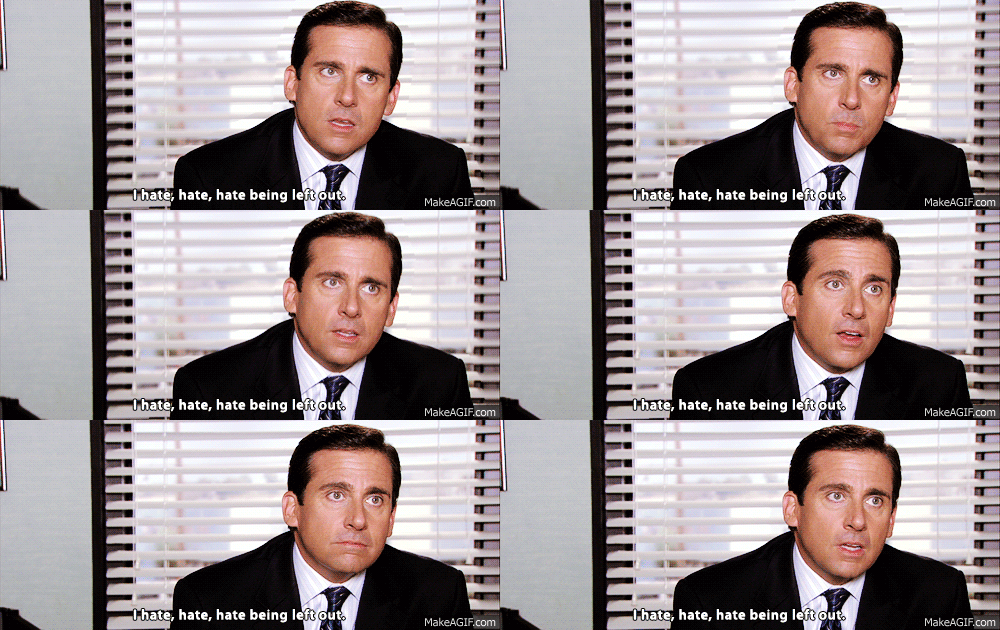
Fear of Missing Out


You were away for a five days of vacationing and you didn't have phone service. It was kind of nice to be disconnected. But now, you're back home and reconnected.

You check your email accounts. Half junk and half things you now need to read and respond to. But what about all the posts you missed on Facebook, Twitter, Instagram and other social networks?

It is difficult to actually scroll through days worth of social media. Leave your Twitter feed unread while you're at work and when you sit down after supper there are hundreds or thousands of missed posts.

If you can just shrug and say "So, I missed some things while I was gone. No big deal," then you have a healthy attitude.

But if you feel like you have to go back and at least glance at what you missed, you may have "fear of missing out" or FoMO.


FoMo is real. It is defined as "a pervasive apprehension that others might be having rewarding experiences from which one is absent."

If you suffer from this newly-recognized social angst, your desire to stay continually connected with what others are doing is strong.

Of course, almost all of us don't want to miss out on good things. The crew from your office went out last Friday after work for drinks and had a great time. You were away at a meeting all day and missed it. Do you feel regret?

With FoMo that regret is a compulsive concern. It makes you question decisions on how you spend your time.

"Things could have been so different if I had only..." is a a common FoMo thought.

This didn't start with the Internet. Fifty years ago without the Net or mobile phones people were worried that they might miss out on important things. I have given up subscriptions to print magazines and newspapers because they were piling up unread and I couldn't bear to just recycle them unread for fear that there was some story or article that I would really love. (Somehow I can easily ignore/delete digital issues of those same publications.)

25 years ago, if I went on vacation, I would come home and wonder what I missed. I'd look at the local paper and talk to friends. There usually wasn't much that had happened.

But technology has moved so much social and communicative experiences online, and it moves so fast and with so much content that we just "know" that we have missed a lot.

It is said that social networking services allow us the opportunity to be socially engaged with a reduced "cost of admission." I have more contact and "conversations" with people I went to high school with on Facebook than I ever did when we were in school together. Is that sad or wonderful?

A psychological dependence on staying connected can certainly produce anxiety when you are disconnected. Fear of missing out has become more than a meme. It is something that has a negative influence on people's psychological health and well-being.

Advertisers have known about this for a long time and used it. Campaigns based on "not missing out" and feeling included in the popular or "in" group are classics. I once belonged to the Pepsi Generation and was also a "Pepper."


1979 Commercial for Dr. Pepper soda with David Naughton (An American Werewolf in London)

The cure for all this seems simple: disconnect. But that is no more of a solution than telling anyone with an addiction to just stop giving in to the desire to use.

Step One: Recognize the problem.  Disconnect from all media for a weekend. No phones, TV, or news in any form. Go to a desert island of your own making. Then, monitor how you act during the weekend and also how you when you return to the world. Any fear that you missed out on some good things?


MORE

http://time.com/4358140/overcome-fomo/

https://www.sciencedaily.com/releases/2016/03/160330135623.htm

http://www.huffingtonpost.com/quora/how-can-i-let-go-of-my-fe_b_12575496.html