Services

Showing posts with label words. Show all posts

Times of Day


Why did humans need fixed times of the day, like "noon" and "midnight"? 

I was wondering about these terms and writing a post for my origins blog, and came across additional information beyond etymologies that I'll post here.

There are several answers to why humans needed fixed times of the day. We love to organize things, and communal life included religious rituals, markets, work schedules, and meetings, and those needed a shared system of timekeeping. 

Times of day allowed long-distance coordination as societies expanded and trade increased, people needed consistent points of reference—even if the Sun wasn’t visible.

Things like contracts, taxes, leases, transportation, and recordkeeping all require clear definitions of when one day ends and another begins. 

These official - and eventually precise - times of day enabled scientific and navigational progress since astronomy, calendars, and navigation at sea relied heavily on precise solar measurements—especially noon.

fixed times of day like noon and midnight to organize life around the natural rhythms of light, darkness, and the movement of the Sun. These terms didn’t appear all at once—they evolved over thousands of years as people developed more precise ways to measure time. 

Noon originally meant the moment when the Sun reached its highest point in the sky. This is now called "solar noon." This was a natural reference point for early societies: The Sun’s highest point was a dependable daily marker. It divided the daylight into “before” and “after.” Farmers, travelers, priests, and traders could all use it to coordinate activities. 

In ancient civilizations — Egypt, Mesopotamia, Greece, and Rome — solar noon was the anchor for their earliest "clocks" (like sundials). Even when mechanical clocks arrived in the Middle Ages, they were adjusted every so often to match the actual solar noon. 

 The word shifted over time: In medieval Latin and Old English, nona meant the ninth hour after sunrise (about 3 p.m.). Over centuries, the prayer schedules of monks shifted, and by the 14th–15th century, English speakers were using noon to mean 12:00.

Midnight is the natural opposite of noon, and after noon was defined as the midpoint of the daylight period; it made sense to divide the entire 24-hour cycle into two halves. Midnight became the point exactly opposite solar noon. A convenient boundary between one day and the next, and it was a reference point for the start of calendars, laws, and later, timetables. 

Before mechanical clocks, people didn’t think much about precise (hours and minutes), and night was divided into “watches,” or segments, mainly for keeping guard. Mechanical clocks (1300s onward) made a precise 12:00 a.m. possible. When time zones were standardized in the 19th century for railroads, midnight officially became the start of the civil day.

What Would Freud Say About That?


We have all said and heard someone say something that is considered to be a "Freudian slip." We attach that phrase to what are often embarrassing slips of the tongue. Though sometimes we just accidentally use the wrong word, in the Freudian cases we interpret them to be more revealing of some unconscious thought.

In the cartoon example above "another" becomes "your mother" - mothers and fathers being big in Freud's view of psychology. In another example, a man saying that he was unhappy and felt a "need to change my wife" when he meant to say "a need to change my life," it would be easy to psychoanalyze his slip as meaning much more than a linguistic error.

Freud wrote:
"In the same way that psycho-analysis makes use of dream interpretation, it also profits by the study of the numerous little slips and mistakes which people make—symptomatic actions, as they are called [...] I have pointed out that these phenomena are not accidental, that they require more than physiological explanations, that they have a meaning and can be interpreted, and that one is justified in inferring from them the presence of restrained or repressed impulses and intentions. [Freud, An Autobiographical Study (1925)]
Freud believed that it was our unconscious mind that unlocked our behaviors and, like dreams, slips of the tongue revealed those hidden thoughts. he never called them "Freudian slips" but referred to these mistakes as Fehlleistungen meaning "faulty actions", "faulty functions" or "misperformances" in German.

Freud's English translator used the term parapraxes  and also the phrase "symptomatic action," both of which are still used today. (more on the word origins)

A Freudian slip of the tongue is an error that is popularly believed to carry hidden meanings. But Freud’s original use of the term ‘parapraxis’ actually included a wider range of common mistakes in behavior. He cataloged and analyzed errors in reading and writing, forgetting someone’s name, mislaying an object, or failing to perform a particular action.

Not all of Freud's theories are still accepted. there are many psychologists and linguists that believe that many cases of Freudian slips are really more indicators of the way language is formed in the brain rather than unconscious thoughts slipping out.

Even in his own time, an Austrian linguist, Rudolf Meringer, had also collected verbal mistakes, but concluded that in most cases they occurred from mixing up letters, not the full words.

In order to produce speech, the brain uses the semantic, lexical and phonological networks and speech requires via the interaction of all three networks. When these interactions malfunction, you get a slip or error.

There are many examples of Freudian slips, but the most famous ones usually come from the most famous people.

Then Vice-President, George H.W Bush gave a speech on live television in 1988 and said “We’ve had triumphs. Made some mistakes. We’ve had some sex… uh… setbacks” The audience did think there was something else going on in his mind.

UK journalist Jim Naughtie on the BBC Radio accidentally pronounced then-Culture Secretary Jeremy Hunt’s surname as cunt.

Condoleezza Rice, National Security Advisor to President Bush, said at a White House dinner party: “As I was telling my husb — as I was telling President Bush...”

Pope Francis was delivering a sermon at the Vatican in 2014, when he accidentally said cazzo instead of caso. Unfortunately, the latter means "example" while the former translates as "fuck."

Senator Ted Kennedy gave a speech about education and said “Our national interest ought to be to encourage the breast - the best - and brightest.”

So, are all these examples evidence of the unconscious speaking out? Ot are they examples of a linguistic misfire?  I tend to side on believing that Freudian slips do not reveal our innermost or darkest secrets, but rather a way in which our brain sometimes mis-processes language. But some of these examples are hard not to consider as being a bit more than just simple mistakes.


The Mystery of Ambrose Bierce


Quotation, noun: The act of repeating erroneously the words of another.
― Ambrose Bierce, The Unabridged Devil's Dictionary

Ambrose Bierce (1842-1914), was a friend and rival of Mark Twain and one of nineteenth-century America's most renowned satirists. A Union veteran of the Civil War, he became one of the best-known writers and journalists in the country.

Bierce's book The Devil's Dictionary was named as one of "The 100 Greatest Masterpieces of American Literature" by the American Revolution Bicentennial Administration.

His story "An Occurrence at Owl Creek Bridge" has been described as "one of the most famous and frequently anthologized stories in American literature." Author Kurt Vonnegut wrote: "... I consider anybody a twerp who hasn't read the greatest American short story, which is '[An] Occurrence at Owl Creek Bridge,' by Ambrose Bierce. It isn't remotely political. It is a flawless example of American genius, like 'Sophisticated Lady' by Duke Ellington or the Franklin stove."

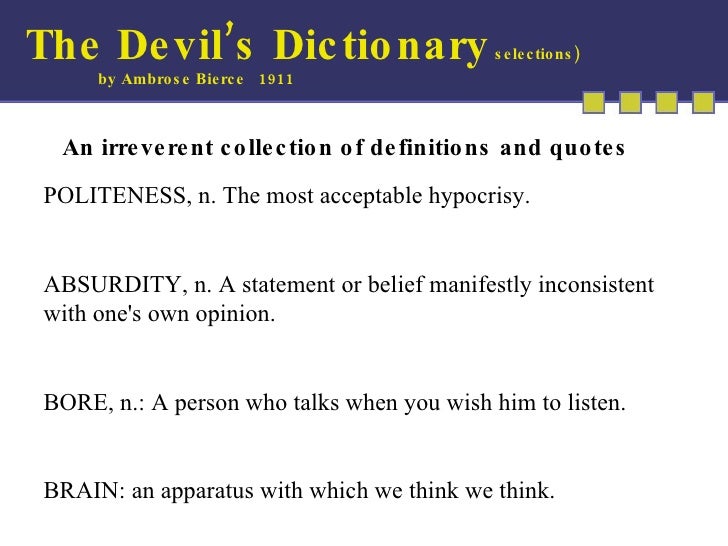
His The Unabridged Devil's Dictionary of epigrams, essays, verses, and vignettes targets the religious, the romantic, the political, and the economic, in equal measure.


Acquaintance, n.: A person whom we know well enough to borrow from but not well enough to lend to.
Bride, n.: A woman with a great future behind her.
Consult, v: To seek another's approval of a course already decided on.


Bierce employed a distinctive style of writing, especially in his stories. This style often embraces an abrupt beginning, dark imagery, vague references to time, limited descriptions, the theme of war, and impossible events.

One of the best known things about Bierce is something we don't know - how he died.

In October 1913, Bierce, then age 71, departed from Washington, D.C. for a tour of his old Civil War battlefields. By December he had passed through Louisiana and Texas, crossing by way of El Paso into Mexico, which was in the throes of revolution.

He joined Pancho Villa's army as an observer, and in that role he witnessed the Battle of Tierra Blanca and made it as far as the city of Chihuahua. His last known communication with the world was a [purported] letter he wrote there dated December 26 which ended "As to me, I leave here tomorrow for an unknown destination."

He vanished without a trace, his disappearance becoming one of the most famous in American literary history. An official investigation by U.S. consular officials found nothing.

Bierce's friend and biographer Walter Neale said that Bierce had not ridden horses for quite some time, was suffering from serious asthma, and had been severely critical of Pancho Villa, and so concluded that it would have been highly unlikely for Bierce to have gone to Mexico and joined Villa.

Despite a lack of hard evidence that Bierce had gone to Mexico, there is also none that he had not. Therefore, despite an abundance of theories (including suicide), his end remains a mystery.

The edition of his dictionary shown here is illustrated by Ralph Steadman. This artist, writer, sculptor, political cartoonist, and designer of labels for vintage wines, is the author/illustrator of the novel Doodaaa, as well as the illustrator of Lewis Carroll's Alice, George Orwell's Animal Farm, and Hunter S Thompson's Fear and Loathing in Las Vegas.