Services

Showing posts with label brain. Show all posts

Talking to Yourself: Making the Abstract Concrete


Talking to yourself may seem like something only eccentric people do, but in reality, it’s one of the most powerful tools your brain has for learning. 

Psychologists call it “self-talk” or “verbal thinking,” and it turns out to be a natural way for the mind to organize information, strengthen memory, and manage emotions. From early childhood onward, people often speak their thoughts out loud when trying to focus, solve problems, or make decisions. What appears to be idle chatter is actually an important part of how we think, learn, and remember.

When you talk to yourself, you are taking something abstract—your thoughts—and turning it into concrete language. This process externalizes your thinking, forcing you to arrange ideas in a logical order and to make sense of them as you speak. For example, saying to yourself, “First I need to understand this equation, then I can solve for x,” not only guides your actions but helps you organize the steps of reasoning in your mind. It is similar to what teachers do when they “think aloud” to demonstrate problem-solving to students. By hearing the reasoning out loud, students (and the speakers themselves) make sense of what would otherwise stay vague and internal.

Verbal thinking also stimulates several regions of the brain at once. When you speak out loud, you engage the areas responsible for producing and understanding language, but you also activate regions that handle movement, auditory processing, and memory. The combination of seeing, saying, and hearing information gives your brain multiple forms of input. This makes the learning experience richer and more durable. The more sensory systems involved in processing information, the more connections your brain can form to that information, making it easier to recall later.

Another important benefit of self-talk is its ability to focus attention. The human mind is easily distracted, and silent thinking often drifts from one idea to another. Speaking your thoughts out loud provides a kind of anchor. It keeps your attention fixed on what you’re doing and reminds you of your goal. When a student says, “Now I’m going to summarize this paragraph,” the spoken sentence reinforces their intention and helps them resist distractions. It’s an act of self-regulation, similar to how athletes talk themselves through complex routines or how drivers might mutter directions to stay alert. This form of spoken focus can be particularly useful during long study sessions or demanding projects when concentration begins to waver.

Talking to yourself also strengthens memory and retention. Researchers have identified something called the “production effect,” which refers to the improvement in recall that happens when people say information out loud instead of just reading it silently. The act of speaking forces the brain to encode the material more actively. By engaging the muscles of speech and the auditory system, the learner creates a stronger and more distinctive memory trace. It’s the difference between passively seeing a word on a page and hearing yourself pronounce it. Students who read definitions, formulas, or historical facts aloud are often surprised at how much more easily they can remember them later.

Self-talk doesn’t just help you remember—it helps you reason. When you talk through a problem, you make your thought process more deliberate. This slows down your reasoning just enough for you to examine each step carefully. It encourages what psychologists call metacognition, or “thinking about thinking.” Through metacognition, you can notice mistakes, test strategies, and decide whether your approach is working. For instance, a math student might talk through a geometry proof step by step, catching logical errors along the way. A writer might read a paragraph aloud and suddenly notice awkward phrasing or unclear ideas that seemed fine when silent. Verbal thinking allows you to monitor your own understanding in real time.

There is also a strong emotional component to self-talk. The way we speak to ourselves can influence our mood, motivation, and even stress levels. Encouraging phrases like “I can do this” or “Let’s stay calm and try again” may sound simple, but they trigger neural pathways related to self-regulation and resilience. Positive self-talk can reduce anxiety and help maintain focus, especially under pressure. On the other hand, harsh or negative self-talk can increase stress and make learning harder. The words we use toward ourselves matter because the brain responds to them much as it would to hearing them from another person. Students preparing for an exam, athletes training for competition, or performers rehearsing for a show often rely on self-talk to boost confidence and control nerves.

Another way talking to yourself aids learning is by revealing what you don’t yet understand. When you try to explain something aloud, even if no one else is listening, you quickly discover the gaps in your knowledge. You might realize you can repeat facts but can’t explain why they are true, or that you understand a process in general but not in detail. This experience of running into the limits of your understanding is valuable—it tells you exactly what to study next. The physicist Richard Feynman promoted this approach, now called the “Feynman Technique,” which involves explaining a concept as if you were teaching it to someone else. If you can’t explain it clearly, you don’t fully understand it. Talking to yourself works the same way.

Over time, verbal thinking can also improve communication and writing skills. Speaking forces you to choose words, build sentences, and express ideas coherently. The more you do it, the easier it becomes to translate thoughts into clear language. Students who practice summarizing readings or explaining theories out loud often find their essays and presentations become sharper and more confident. By strengthening the connection between thought and expression, self-talk develops both intellectual and linguistic ability.

Interestingly, children use self-talk quite naturally as they learn. Developmental psychologist Lev Vygotsky observed that young children often talk to themselves while playing or solving puzzles. This “private speech,” as he called it, helps them guide their own behavior and internalize complex tasks. As people grow older, they tend to silence that speech and replace it with inner thought, but the cognitive function remains the same. Adults who consciously reintroduce verbal thinking often rediscover how effective it can be for focusing attention and understanding difficult material.

In modern classrooms and study environments, students are sometimes encouraged to work quietly, but silence is not always the most productive condition for the brain. Whispering through an explanation, summarizing a passage aloud, or narrating steps in a science experiment can make learning more active and engaging. Some students even record themselves explaining topics and play them back to reinforce memory. The goal isn’t to fill the room with chatter, but to use speech strategically as a mental tool.

Talking to yourself, then, is far from a sign of oddness or distraction. It’s an advanced cognitive strategy that integrates language, thought, and emotion. It transforms learning from a passive act of receiving information into an active process of constructing meaning. When you speak your thoughts, you are essentially teaching yourself, reinforcing what you know, and identifying what you don’t. You involve multiple senses, strengthen neural connections, and give your ideas a clearer shape.

Whether you’re studying for an exam, learning a new skill, or simply trying to organize your day, giving voice to your thoughts can make a noticeable difference. It helps you focus, remember, reason, and stay motivated. The next time you catch yourself talking out loud while working through a problem, don’t be embarrassed. You’re not losing your mind—you’re using it in one of the most effective ways possible.

Memory Times Three

I have another site about words The word "memory" is all over our language, especially in idioms. Clear it, jog it, have it etched in your mind, stroll down memory lane, lose your train of thought, have a mental picture, or have something slip your mind. Maybe your memory is like a sieve, or you can remember like an elephant, perhaps even have a mind like a steel trap.

There are so many ways to describe memory. A neurobiologist, such as Flavio Donato, University of Basel, will do it differently than the rest of us. His studies suggest that memories are left in multiple traces—or patterns of neuronal activity—each on a different population of neurons.

These groups of neurons form at different stages of the brain’s development and are found in the hippocampus. The hippocampus is a small, seahorse-shaped brain structure located in the medial temporal lobe, crucial for forming new memories, learning, and spatial navigation, and is part of the limbic system. 

1. Neurons emerge in embryonic development; they create stability for long-term memories.
2. Following these “early-born” neurons are “late-born” neurons, primarily used to retrieve short-term memories
3. During an intermediate stage of embryonic development, neurons form that are used for the recollection of a memory at both recent and remote time points.

So, a single memory of yours is left in multiple traces.

The 3 Stages of Memory

Photo by Robina Weermeijer on Unsplash

Our current theory on memory is that though we have one memory system, it has three separate stages — sensory, short-term, and long-term.

Sensory memory is very short-term. This memory lasts less than half a second. That seems almost useless, but it allows you to capture an image, sound, or other sensation. These very brief not-even-moments then move immediately into short-term memory.

Short-term memory (which some theorists prefer to call "working memory") is both a filter and temporary storage. In this stage, we will either push out the memory or put it into long-term memory storage.

When a login code is sent to my phone that temporary popup is in my short-term memory, used, and then filtered out as non-essential. I certainly can't recall it a minute later. So, the filtering of these memories and discarding is a good thing. I don't want to remember everything I experience, see or hear forever.

Long-term memory holds valuable memories, although how that value is determined is not really understood. These memories are about as permanent as our memory gets and theoretically long-term memory can store unlimited amounts of information indefinitely.

These memories are stronger. It is why you can recall something from your childhood that happened 40 years ago. There are several reasons why these memories are retained. For example, recalling an event multiple times does put it more securely into long-term storage. Retelling that funny story from your vacation to multiple people over the course of months and years not only helps retain it but actually alters the memory.

The part that interests me more and more and I and my friends and family age is short-term memory since that is the part we lose as we get older.

Short-term memory seems to be temporarily stored for only 15-30 seconds. Brain studies have shown that the consolidation of short-term memories into long-term memories largely takes place in the hippocampus. But we don't have a "place" in the brain for short-term memory.

I take a deeper dive into short-term memory and some ways you might be able to improve it in an article I wrote at Weekends in Paradelle.


The Face in Your Mind

The "Face on Mars"

When you see a face, what tells you that it is a face?

Humans are good at recognizing faces. We even see "faces" where there are no faces - in clouds, on a piece of toast, a man in the moon. A satellite photo of a mesa in the Cydonia region of Mars has been nicknamed the "Face on Mars." I don't see it as any evidence of extraterrestrial habitation, but just a natural rock formation. But it definitely registers as a face.

Neuroscientists have been studying this ability and it is part of what is labeled as pareidolia. Pareidolia is a psychological phenomenon in which the mind responds to a stimulus (an image or a sound) by perceiving a familiar pattern where none exists

Why do most of us have the ability to tell one face from another, even if the differences are extremely small?

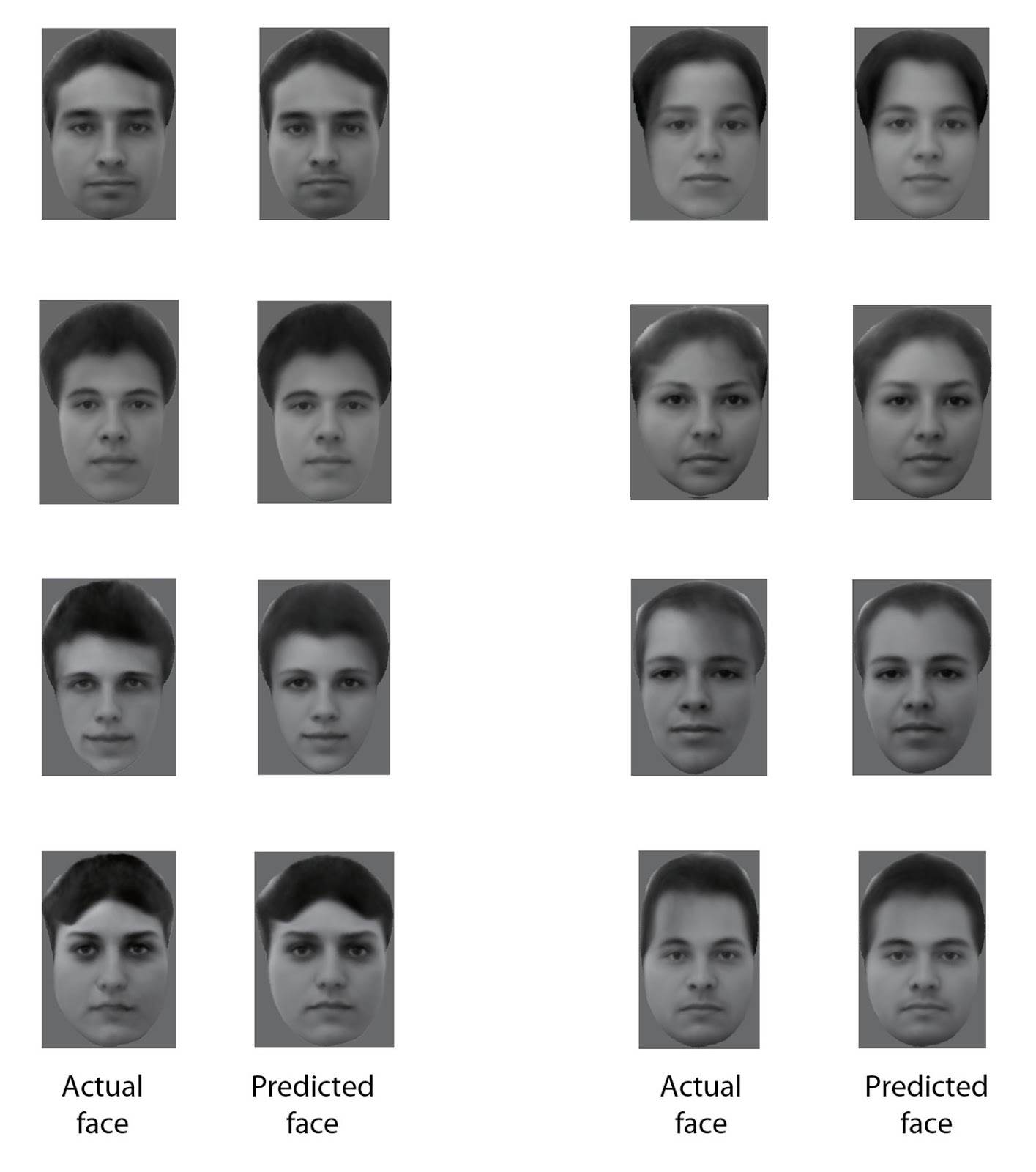
Some rather amazing research from the California Institute of Technology was done with macaques, a genus of monkey. Researchers identified a small group of neurons that they believe specialize in picking out individual features of faces and creating a single image.

The macaques wore EEG caps as they looked at a series of several thousand faces and recorded which neurons were active. They believe they even identified specific neurons that corresponded to different features.


The amazing part is that then working backwards they tried to reassemble faces using the information from firing neurons. They were able to rebuild very accurate versions of the faces that had been viewed. Recognizing faces seems to be a process of breaking faces apart into smaller parts for recognition. We still don't know the whole process. For example, why can we pick out a recognizable face in a crowd?

It seems that the brain’s ability to see faces from random objects is due to "configural processing." Do we always need to put together the components — eyes, nose, ears? Sometimes we just seem to recognize a face when we see it.

What can this research lead to? If researchers could stimulate the right cells in the brain of a blind person, it should be possible to give that person the experience of seeing a face, though they wouldn't actually be seeing someone with their eyes.

Sources and Further Reading
www.npr.org
blogs.discovermagazine.com

My, What Big Pupils You Have


The pupil is a hole located in the center of the iris that allows light to strike the retina. It appears black because light rays entering the pupil are absorbed. (The iris is the colored part.) You know that its size varies due to the amount of light, your emotional state, cognitive effort, drugs and, well, death.

A dark room means it dilates to allow more light. The same is true for an orgasm, a difficult test question and when you're lying. "Lying Eyes" isn't just an Eagles song, because pupil dilation is considered a reliable indicator of lying. Enlarged pupils are a sign that your brain is working hard, and that happens when you lie.

The study of all this, pupillometry, is often used in psychological research.

So, saying someone has big pupils probably isn't a compliment. Or is it? Scientists have known for more than 50 years that the size of the pupil is related to more than just the amount of light entering the eyes.

A standard experiment in memory shows that the pupil dilates each time a new item is held in memory (more difficult),  and constricts as each item is subsequently recalled (easier).

A recent study found that:
Pupil dilations of the eye are known to correspond to central cognitive processes. However, the relationship between pupil size and individual differences in cognitive ability is not as well studied. A peculiar finding that has cropped up in this research is that those high on cognitive ability have a larger pupil size, even during a passive baseline condition. 

It seems that there is relationship between pupil size and cognitive ability across individuals. The researchers looked at the correlation between baseline (resting) pupil diameter and fluid intelligence. Fluid intelligence is thought to be a major component of IQ.

Yes, the paper also admits that "these findings were incidental and lacked a clear explanation" but maybe this means that saying you have big pupils is really a compliment.

I have also read that pupil size diminishes with age. What's with that?

Psychedelic Baby Brain


Some experimenters looked at the brains of people who ave had at least one experience with a psychedelic drug like LSD, magic mushrooms, ayahuasca etc. They gave them a moderate dose of LSD - one hit or blotter of LSD, which is typical when taken recreationally. They screened out people who might have "psychological vulnerability."

They found they had brains much like a baby's brain. Meaning? Babies have emotions go up and down - happy, ecstatic, then crying. The subjects also experienced this, along with emotional sensitivities and hyper-imaginative moments and a childlike sense of wonder and awe about the world.

That might be seen as mystical or spiritual way, or simply the wonder of the very young.

The poet William Wordsworth talked about the infant state as a heavenly state where we're closer to what you might call God.

Listen to an NPR story about this

Your Winter Brain


Is there seasonality in our brain responses? Is your winter brain any different from your summer brain?


At least one study suggests that our brain function goes through seasonal cycles. Seasons just might have an effect on cognitive brain function.

The volunteers spent four and a half days in a laboratory “devoid of seasonal cues.” Then they did brain scans as they performed cognitive tasks, one measuring sustained attention, and another executive function. The researchers were looking to see if the season in which the fMRI scan took place was correlated with brain activity during the tasks.

There were some significant correlations and across several brain areas neural activity followed a seasonal cycle.

I'm sure that you "feel" different in different seasons, but do you notice any difference if you cognitive performance?

I had a professor years ago that said that no great research comes from places where it is always summer. He was half, but only half, joking.

The study's abstract:
Daily variations in the environment have shaped life on Earth, with circadian cycles identified in most living organisms. Likewise, seasons correspond to annual environmental fluctuations to which organisms have adapted. However, little is known about seasonal variations in human brain physiology. We investigated annual rhythms of brain activity in a cross-sectional study of healthy young participants. They were maintained in an environment free of seasonal cues for 4.5 d, after which brain responses were assessed using functional magnetic resonance imaging (fMRI) while they performed two different cognitive tasks. Brain responses to both tasks varied significantly across seasons, but the phase of these annual rhythms was strikingly different, speaking for a complex impact of season on human brain function. For the sustained attention task, the maximum and minimum responses were located around summer and winter solstices, respectively, whereas for the working memory task, maximum and minimum responses were observed around autumn and spring equinoxes. These findings reveal previously unappreciated process-specific seasonality in human cognitive brain function that could contribute to intraindividual cognitive changes at specific times of year and changes in affective control in vulnerable populations. 

I wasn't able to find which season showed the best performance. And the seasons did not hinder the participants’ overall performances. But the surprise was that the brain activity mapping suggests that different areas of the brain activate based on the season.

More research needs to be done, and there are skeptics about these early finding. Up next for the researchers is to understand how biochemical changes and specific seasonal cues, such as temperature, humidity, and the length of the day also have an impact on brain activity.

I think this post would have been better if I hadn't written it during winter.