Services

Showing posts with label research. Show all posts

The Face in Your Mind

The "Face on Mars"

When you see a face, what tells you that it is a face?

Humans are good at recognizing faces. We even see "faces" where there are no faces - in clouds, on a piece of toast, a man in the moon. A satellite photo of a mesa in the Cydonia region of Mars has been nicknamed the "Face on Mars." I don't see it as any evidence of extraterrestrial habitation, but just a natural rock formation. But it definitely registers as a face.

Neuroscientists have been studying this ability and it is part of what is labeled as pareidolia. Pareidolia is a psychological phenomenon in which the mind responds to a stimulus (an image or a sound) by perceiving a familiar pattern where none exists

Why do most of us have the ability to tell one face from another, even if the differences are extremely small?

Some rather amazing research from the California Institute of Technology was done with macaques, a genus of monkey. Researchers identified a small group of neurons that they believe specialize in picking out individual features of faces and creating a single image.

The macaques wore EEG caps as they looked at a series of several thousand faces and recorded which neurons were active. They believe they even identified specific neurons that corresponded to different features.
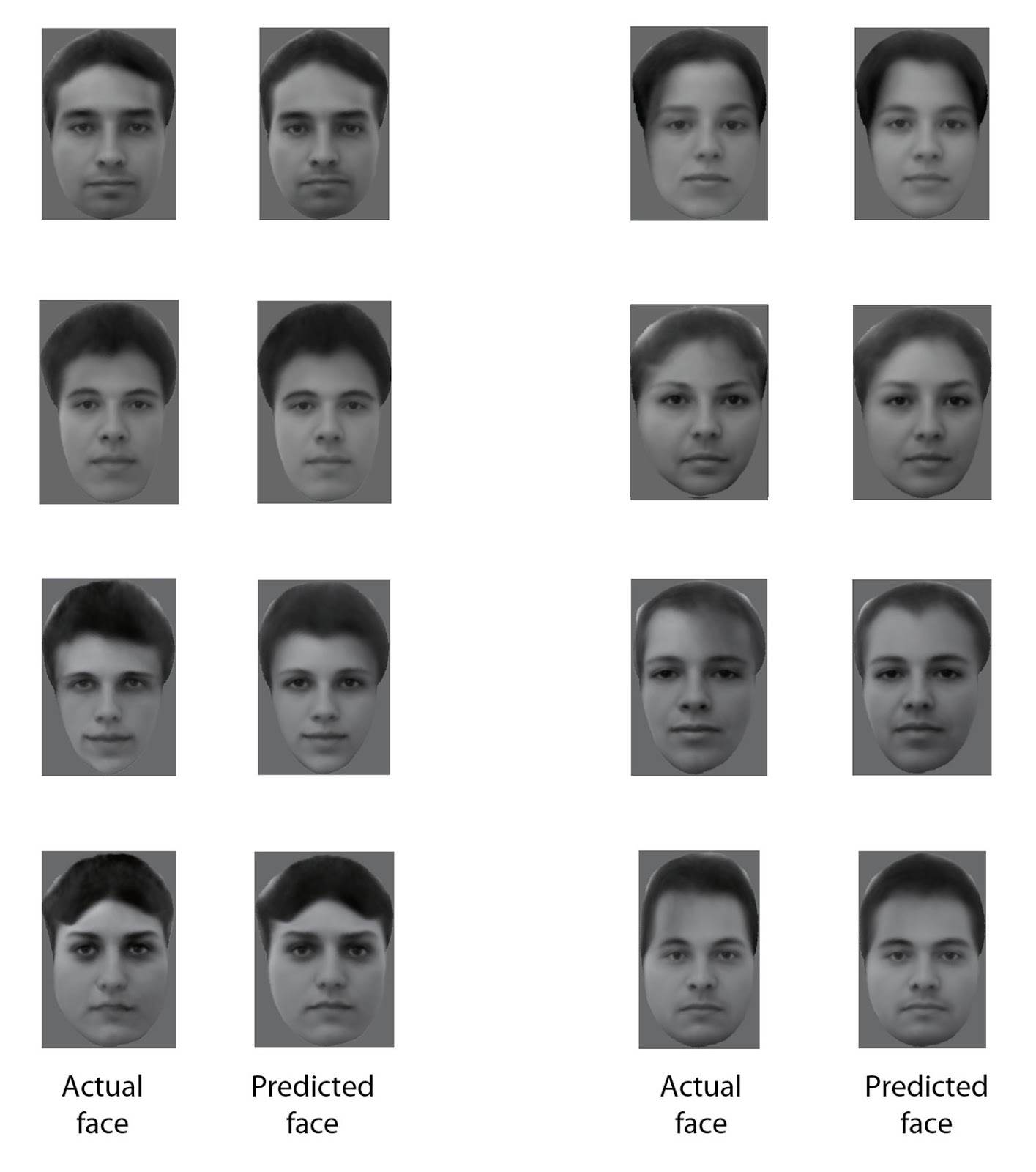

The amazing part is that then working backwards they tried to reassemble faces using the information from firing neurons. They were able to rebuild very accurate versions of the faces that had been viewed. Recognizing faces seems to be a process of breaking faces apart into smaller parts for recognition. We still don't know the whole process. For example, why can we pick out a recognizable face in a crowd?

It seems that the brain’s ability to see faces from random objects is due to "configural processing." Do we always need to put together the components — eyes, nose, ears? Sometimes we just seem to recognize a face when we see it.

What can this research lead to? If researchers could stimulate the right cells in the brain of a blind person, it should be possible to give that person the experience of seeing a face, though they wouldn't actually be seeing someone with their eyes.

Sources and Further Reading
www.npr.org
blogs.discovermagazine.com

My, What Big Pupils You Have


The pupil is a hole located in the center of the iris that allows light to strike the retina. It appears black because light rays entering the pupil are absorbed. (The iris is the colored part.) You know that its size varies due to the amount of light, your emotional state, cognitive effort, drugs and, well, death.

A dark room means it dilates to allow more light. The same is true for an orgasm, a difficult test question and when you're lying. "Lying Eyes" isn't just an Eagles song, because pupil dilation is considered a reliable indicator of lying. Enlarged pupils are a sign that your brain is working hard, and that happens when you lie.

The study of all this, pupillometry, is often used in psychological research.

So, saying someone has big pupils probably isn't a compliment. Or is it? Scientists have known for more than 50 years that the size of the pupil is related to more than just the amount of light entering the eyes.

A standard experiment in memory shows that the pupil dilates each time a new item is held in memory (more difficult),  and constricts as each item is subsequently recalled (easier).

A recent study found that:
Pupil dilations of the eye are known to correspond to central cognitive processes. However, the relationship between pupil size and individual differences in cognitive ability is not as well studied. A peculiar finding that has cropped up in this research is that those high on cognitive ability have a larger pupil size, even during a passive baseline condition. 

It seems that there is relationship between pupil size and cognitive ability across individuals. The researchers looked at the correlation between baseline (resting) pupil diameter and fluid intelligence. Fluid intelligence is thought to be a major component of IQ.

Yes, the paper also admits that "these findings were incidental and lacked a clear explanation" but maybe this means that saying you have big pupils is really a compliment.

I have also read that pupil size diminishes with age. What's with that?

Vacation


Spoiler alert: Summer is half over. Vacations can happen in any season but there is something about summer vacations that overpowers the other seasons. I blame school summer vacations. Those two months off have built industries for camps, theme parks and even National Parks.

And we dump a lot of money and time and energy into planning them.

The smart and funny podcast HIDDEN BRAIN did a summer edition looking at what social science research has to say about vacations (listen)

Some researchers found that where you are when you book vacation lodging matters more than you might realize. People who booked hotels while at work generally purchased more luxurious accommodations than those who booked their vacation hotels from home. Do work at work and stop doing personal stuff! Another reason to do it at home is that those who booked from the workplace were less satisfied.

Other research found that the exotic and extraordinary vacation experience is hard to share and that seems to matter in the vacationer's ultimate experience.

Do you put on a few pounds on vacation? Do you try to drop a few before vacation? Adults gained about 3/4ths of a pound while on vacation, a gain that persisted even six weeks later. That's nothing.  expect at least 5 pounds if it's something like a cruise with lots of good stuff to eat.

How can this be? I am more active on vacation - swimming, walking, playing beachy games. Apparently, the food and also the alcohol (often twice as much as usual) far outweighs the activity.

How long do the vacation good vibes last when you go back to work? Research shows about a month, though I have lost that glow after a week and once I recall saying to my wife that the week off was all gone after one day back at work.

Still, I have seen other research multiple times that shows that experiences - like vacations - have a much stronger and longer lasting uplifting effect on you than buying "things."  A week at the resort with your mate is better than an equally expensive piece of jewelry.

Psychedelic Baby Brain


Some experimenters looked at the brains of people who ave had at least one experience with a psychedelic drug like LSD, magic mushrooms, ayahuasca etc. They gave them a moderate dose of LSD - one hit or blotter of LSD, which is typical when taken recreationally. They screened out people who might have "psychological vulnerability."

They found they had brains much like a baby's brain. Meaning? Babies have emotions go up and down - happy, ecstatic, then crying. The subjects also experienced this, along with emotional sensitivities and hyper-imaginative moments and a childlike sense of wonder and awe about the world.

That might be seen as mystical or spiritual way, or simply the wonder of the very young.

The poet William Wordsworth talked about the infant state as a heavenly state where we're closer to what you might call God.

Listen to an NPR story about this

Your Winter Brain


Is there seasonality in our brain responses? Is your winter brain any different from your summer brain?


At least one study suggests that our brain function goes through seasonal cycles. Seasons just might have an effect on cognitive brain function.

The volunteers spent four and a half days in a laboratory “devoid of seasonal cues.” Then they did brain scans as they performed cognitive tasks, one measuring sustained attention, and another executive function. The researchers were looking to see if the season in which the fMRI scan took place was correlated with brain activity during the tasks.

There were some significant correlations and across several brain areas neural activity followed a seasonal cycle.

I'm sure that you "feel" different in different seasons, but do you notice any difference if you cognitive performance?

I had a professor years ago that said that no great research comes from places where it is always summer. He was half, but only half, joking.

The study's abstract:
Daily variations in the environment have shaped life on Earth, with circadian cycles identified in most living organisms. Likewise, seasons correspond to annual environmental fluctuations to which organisms have adapted. However, little is known about seasonal variations in human brain physiology. We investigated annual rhythms of brain activity in a cross-sectional study of healthy young participants. They were maintained in an environment free of seasonal cues for 4.5 d, after which brain responses were assessed using functional magnetic resonance imaging (fMRI) while they performed two different cognitive tasks. Brain responses to both tasks varied significantly across seasons, but the phase of these annual rhythms was strikingly different, speaking for a complex impact of season on human brain function. For the sustained attention task, the maximum and minimum responses were located around summer and winter solstices, respectively, whereas for the working memory task, maximum and minimum responses were observed around autumn and spring equinoxes. These findings reveal previously unappreciated process-specific seasonality in human cognitive brain function that could contribute to intraindividual cognitive changes at specific times of year and changes in affective control in vulnerable populations. 

I wasn't able to find which season showed the best performance. And the seasons did not hinder the participants’ overall performances. But the surprise was that the brain activity mapping suggests that different areas of the brain activate based on the season.

More research needs to be done, and there are skeptics about these early finding. Up next for the researchers is to understand how biochemical changes and specific seasonal cues, such as temperature, humidity, and the length of the day also have an impact on brain activity.

I think this post would have been better if I hadn't written it during winter.