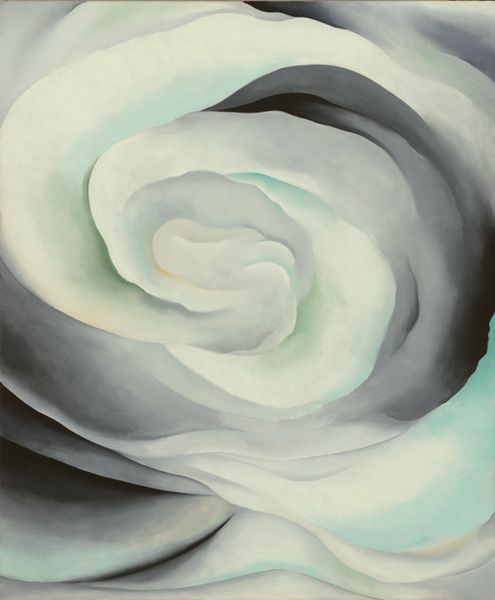
When most people think of Georgia O’Keeffe's art (if they know who she is), they probably picture bleached skulls in the desert, views of clouds, or voluptuous flowers with an erotic charge (that the artist may or may not have intended).
But there are also mixed in there Polaroid prints of her dog, watercolor sketches of ladies, or abstract cast iron pieces.
O'Keefe may be America’s most celebrated female artist. To get beyond her best-known pieces, you can now visit the 1100+ works in the Georgia O’Keeffe Museum’s online collection to get a more complete understanding of the life and work of the iconic artist, who died in 1986 at the age of 98.
You can also view works by other artists in the collection, including two very significant men in her life, photographer Alfred Stieglitz and ceramicist Juan Hamilton.
And watch a documentary introduction to O’Keeffe, narrated by Gene Hackman, below:
Girl with a Pearl Earringis Vermeer’s most famous painting. It is not a portrait, but a ‘tronie’ – a painting of an imaginary figure. Tronies depict a certain type or character; in this case, a girl in exotic dress, wearing an oriental turban and an improbably large pearl in her ear.
Johannes Vermeer was a master of light. His studio workspace was set up so that the light source came from the left side and that is clear in many of his paintings. It is shown here in the softness of the girl’s face and the glimmers of light on her moist lips. And of course, the shining pearl.
Michelangelo Buonarroti, an Italian sculptor, architect, and painter, is sometimes called the original “Renaissance man.” He was born in Tuscany, Italy in 1475. Many know him as the painter of the Sistine Chapel’s elaborate ceiling.
Less well known is that before he was one of history’s greatest artists, Michelangelo was a bit of a con artist.
His patron sponsor convinced him to work at imitating the style of ancient Greek sculpture. He then sold these works as valuable antiques. He even used dirt and weathering to make it seem that these statues would look like they had been buried underground.
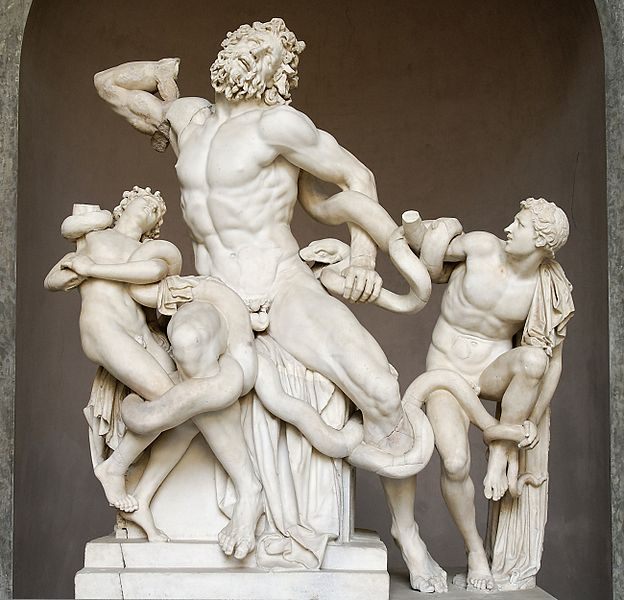
The statue of Laocoon is now rumored to have been another of Michelangelo’s forgeries.
The art dealer, Baldassari del Milanese, sold the sculpture of a sleeping cupid unbeknownst to Michelangelo. But the buyer was a Cardinal, who, once he realized he’d been duped, demanded his money back and was angry with the dealer. The dealer was bold enough to sell that one again. We believe it changed hands several times until it ended up in the Whitehall Palace in London, and perished in the fire that consumed it in 1698.
The Cardinal demanded his money back but was so impressed by Michelangelo’s technical skill with the forgery that he invited him to meet him in Rome. Maybe he thought that the artist has also been conned. That is unclear.
Michelangelo spent a lot of time in the city and in his lifetime he had been commissioned to create work by nine consecutive popes.
Sexting is a new term. Texting on your phone has been around since mobile phones added that function. At first, a sext was sending, receiving, or forwarding a sexually explicit message. When the ability to send images came to phones sexting became a visual thing.
The term was first popularized early in the 21st century and in 2012 sexting was added to Merriam-Webster's Collegiate Dictionary. But I think it may be a lot older than that.
The painting is a selfie of her pale breasts encircled by a swirl of cloth framed in a red box.
I don't know if she sent it around Valentine's Day, but it would make a pretty erotic one.
Sarah took a tradition of “eye miniatures” up several notches. Eye miniatures (which possibly began with one sent by George IV to Maria Anne Fitzherbert) were your eyes painted on small sheets of ivory. The idea was that the miniature painting would be a way to still stare into your lover's eye even when they were away.
Sarah's painting does somewhat resemble eyes, and it was a substitute for being able to gaze into her breasts, which I assume he had seen in person.
Sarah’s relationship with Webster had begun in 1827 and continued until his death in 1852. It's not clear what their relationship entailed. They only saw each other infrequently. He did visit her in Boston a few times. He also paid her to paint portraits of his family. That sounds awkward.
After the death of Webster's first wife, Sarah visited him. But he married someone else and when he separated from his second wife, Sarah visited again.
Did they ever have sex? That sexting selfie painting certainly seemed like an invitation.
The painting is called "Beauty Revealed." Like many sexted photos, it was not a self-portrait. It's just her breasts.
Webster kept the painting his entire life and then it was donated to the Metropolitan Museum of Art by his descendants.
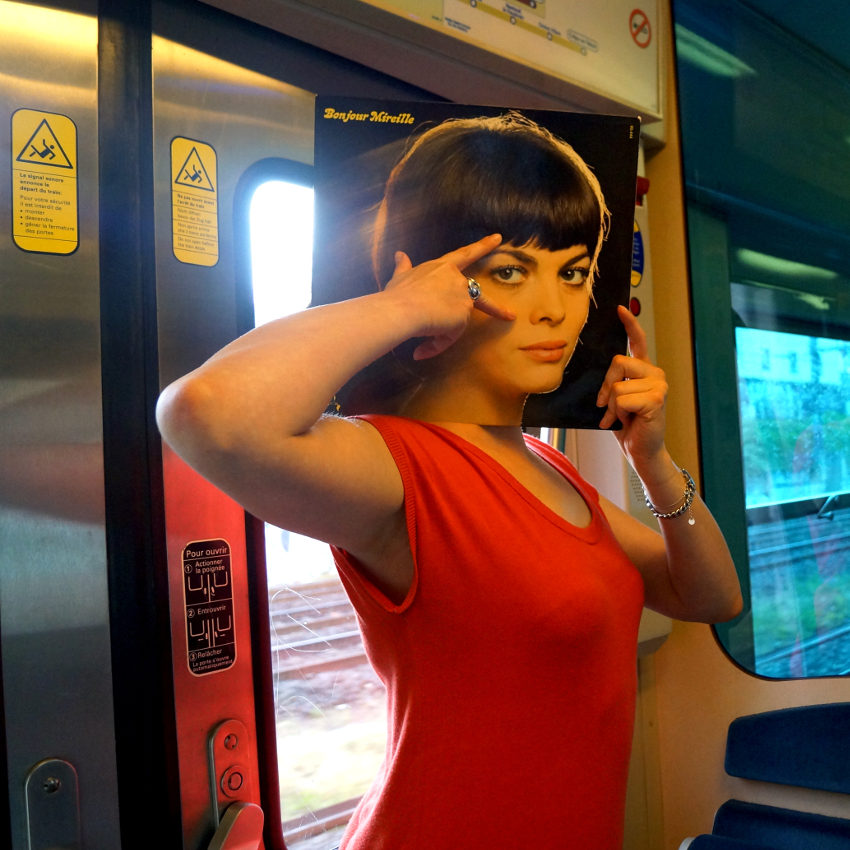
Sleeveface is defined as "one or more persons obscuring or augmenting any part of their body or bodies with record sleeve(s) causing an illusion." It is also a participatory photo project on Instagram. People post photos of themselves that were strategically posed with matching album covers expanding the original album cover picture.
Art imitates life and sometimes life imitates art and sometimes films imitate art.
Filmmaker Vugar Efendi put together a compilation of shots from films along with the paintings that inspired them.
You may have seen filmmakers pay homage to older films by imitating shots - the original Star Wars film has shots that echo a number of other films including John Ford's The Searchers and the Stranger Things series on Netflix has lots of tributes to films from the 1980s that the filmmakers watch and loved.
Paintings may be less obvious. Not everyone would pick up on Jean-Luc Godard filming a shot based on a painting by Jean-Auguste-Dominique Ingres. It is an old tradition. One referenced in Efendi's supercut is from the 1927 silent film Metropolis.
L'empire des lumières influenced William Friedkin's The Exorcist, and La Robe du soir is alluded to in Barry Jenkins' Moonlight while Architecture au clair de Lune slips into Peter Weir's The Truman Show. Some instances are unexpected: Thomas Gainsborough's The Blue Boy used in in Quentin Tarantino's Django Unchained. Sometimes the reference is not exact but a scene feels like it is "in the style of"a painter - such as the look of the Bates's home in Hitchcock's Psycho looking like a house from an Edward Hopper painting - but without the color or sunlight. (Wim Wenders used a much more literal recreation of Edward Hopper's Nighthawks in his film The End of Violence.)
I first saw these videos mentioned on the Slate website, but the three-part video has been posted in other places too.
Here are the pairings so that you can check you "art of the cinema" knowledge.
Some 600 years ago, the Van Eyck brothers created one of the first large-scale oil paintings titled “Adoration of the Mystic Lamb.” It had such detail and realistic portrayal of people, that the “Ghent Altarpiece,” as it is also known, is considered one of the most influential paintings ever made, though it is not commonly known.
In 1432, it was first installed at Saint Bavo Cathedral in what’s now Belgium. But the Altarpiece has been looted, burned and torn apart by multiple armies, including those of Napoleon and the Nazis.
After World War II, the Monuments Men brought it back to back to Ghent, Belgium. You may have learned about The Monuments Men via a movie by that name about this group set up by the Allied armies to protect cultural heritage from the Nazis.
One of the panels, titled "The Just Judges” is still missing following its theft in 1934.
Enter modern technology. The freshly renovated exterior panels of the Altarpiece can now be explored in ultra-high resolution on Google Arts and Culture. Their robotic Art Camera took about 4,000 high-resolution close-ups of the artwork and used those to create the highest ever resolution image ever made of the panels. You can zoom as much as you’d like into more than 8 billion pixels.
If you are new to MOOCs, they are online courses that are offered for free. They are usually university courses, though many are hosted by MOOC providers (edX, Coursera etc.). To many people the experience will not be at all like "taking a course" at a university. It might be your first time learning online, and that is odd for anyone. They are "massive" because you probably will be one of thousands of students in the class. The "lectures" are probably videos and probably (thankfully) much shorter than the 90-minute ones you had in college.
Learners may take a MOOC for credit or to get a certificate of successful completion (it is an option for many courses) and pay a fee (generally far less than typical tuition). But the majority of learners take them for lifelong learning and perhaps professional development with no desire to get credit.
This particular course is an "archived course" which means there is no active instructor. The six-week course was first offered with an instructor in October 2016. EdX keeps courses open for enrollment after they end to allow learners to explore content and continue learning. All features and materials may not be available, and course content will not be updated, but courses are sometimes offered "live" again.
UON has a prestigious Natural History Illustration program. I do some drawing and painting, but I am certainly not an aspiring scientific or medical illustrator. That is one of the great things about these MOOCs. There is very little pressure and no prerequisites to taking a course. A middle school student could attempt one. You need no artistic background. You might want to take it to learn about the topic and not even expect to try drawing yourself.
I audited a few art courses as an undergraduate. I was an English major and they didn't count towards my degree requirements - and I wasn't really good enough to be in those courses, but professors often allowed a few extra students. Professors made it clear that you needed to attend classes and do the assignments, but you would not get the same attention as the tuition-paying students. The MOOC model is similar.
This course is about observing and illustrating subjects from nature, science and culture, with their linkages to the environment being central. My interest is half art interest and half my interest in nature.
My own artwork is not "realistic" so it was a challenge to try creating accurate replications of subjects from the natural world.
Topics included:
- Core scientific observational skills
- Field drawing and sketching techniques
- Concept sketch development
- Composition for natural history illustration
- Form, proportion and structure essentials
- Drawing and rendering techniques
I borrowed a copy of the anniversary edition of Miles Davis' Kind of Blue from my library. It comes with a documentary DVD and includes copies of Bill Evans's handwritten notes (they became the liner notes). It's nice, but at $75, I can get by just fine with my regular CD edition of the album.
I'm no jazz authority. I can't tell you who played alto sax on a track when I hear it unless I'm looking at the liner notes. I need to read other people's writing to have any background on the album. I probably tend to like more jazz that is closer to the border of pop than hardcore jazz. But Kind of Blue is one album I always liked.
I always borrowed jazz albums first before I bought them. I bought Time Out by The Dave Brubeck Quartet after I had borrowed it from the library a few times. Same thing withA Love Supreme by John Coltrane. Not very radical purchases, but then none of my friends listened to any jazz and definitely didn't buy any jazz records.
In 1958, Davis added Bill Evans to his band. Evans was a classically-trained pianist and I think that changed Davis' sound. (Don't ask me to explain modal jazz, but that's what people talk about about here.) Evans left later that year and was replaced by Wynton Kelly.
Spring 1959: Davis was in the studio with a sextet to record what became Kind of Blue and he calls back Evans for the sessions because his piano style was key to the sound. (Kelly played only on "Freddie Freeloader.")
Kind of Blue was/is the best-selling jazz album of all time.
The anniversary set made me reread Bill Evans' liner notes. (Do you miss liner notes and 12" record album covers? I do.)
"There is a Japanese visual art in which the artist is forced to be spontaneous. He must paint on a thin stretched parchment with a special brush and black water paint in such a way that an unnatural or interrupted stroke will destroy the line or break through the parchment. Erasures or changes are impossible. These artists must practice a particular discipline, that of allowing the idea to express itself in communication with their hands in such a direct way that deliberation cannot interfere.
The resulting pictures lack the complex composition and textures of ordinary painting, but it is said that those who see well find something captured that escapes explanation.
This conviction that direct deed is the most meaningful of reflections, I believe, has prompted the evolution of the extremely severe and unique disciplines of the jazz or improvising musician.
Group improvisation is a further challenge. Aside from the weighty technical problem of collective coherent thinking, there is the very human, even social need for sympathy from all members to bend for the common result. This most difficult problem, I think, is beautifully met and solved on this recording. As the painter needs his framework of parchment, the improvising musical group needs its framework in time. Miles Davis presents here frameworks which are exquisite in their simplicity and yet contain all that is necessary to stimulate performance with sure reference to the primary conception.
Miles conceived these settings only hours before the recording dates and arrived with sketches which indicated to the group what was to be played. Therefore, you will hear something close to pure spontaneity in these performances. The group had never played these pieces prior to the recordings and I think without exception the first complete performance of each was a take.
Kind of a zen (small z) thing going on there.
That painting might actually be shodo (calligraphy), but I think he meant brush painting ( sumi-e). That's something I have tried myself.
I try not to lift the brush until the end of the line. No strokes like you're used to in oil paint. No going back over the line.
Calligraphers can sometimes do the whole word in one flowing move.
That lack of complexity can be very freeing.
On this album, that simplicity is what I really like, especially compared to other Miles Davis albums like Bitches Brew which I will freely admit that I don't get.
From what I've read, Miles Davis was not a nice man. If you can separate the work from the man, then it's easier to appreciate the music. That's all I'm writing about here - the music.
One little Davis story that I can appreciate is that in 1964 Jackie DeShannon urged him to use his influence at Columbia Records to get a rock band a contract. He did and that band was The Byrds. Thanks, Miles.
The blog became a book in 2007, also titled The Principles of Uncertainty What is it? Perhaps it is philosophy or art or memoir or sociology. The easy answer is that it is all those things, though that doesn't help classify it - if that's what you want done.
There's text, paintings, and photography. It is a year in a life. Maybe part of the uncertainty is what kind of book she wrote.
Kalman has also illustrated children's books, New Yorker covers for (including the famous map of “Newyorkistan” with Rick Meyerowitz).
She has 12 children’s books include Max Makes a Million, Swami on Rye and What Pete Ate. She also has designed fabric for Isaac Mizrahi, accessories for Kate Spade, sets for the Mark Morris Dance Company and, with her late husband Tibor Kalman, clocks, umbrellas and other accessories for the Museum of Modern Art. She lives in New York City and teaches graduate courses in design at the School of Visual Arts.
She also took on the task in 2005 of illustrating the venerable The Elements of Style and had a new way of looking at Strunk and White's reference classic with rather whimsical illustrations.






 from my library. It comes with a documentary DVD and includes copies of Bill Evans's handwritten notes (they became the liner notes). It's nice, but at $75, I can get by just fine with my
  of the album.
 after I had borrowed it from the library a few times. Same thing with
  . Not very radical purchases, but then none of my friends listened to any jazz and definitely didn't buy any jazz records.
 albums to listen to before I bought one. And, like many kids, I really liked
  piano on that

 which I will freely admit that I don't get.
 urged him to use his influence at Columbia Records to get a rock band a contract. He did and that band was

