Services

Showing posts with label music. Show all posts

The Day the Music Died


It was on February 3, 1959, that rock stars Buddy Holly, Ritchie Valens, and J.P. “The Big Bopper” Richardson died in a plane crash outside Clear Lake, Iowa. McLean was a 13-year-old paperboy when the crash happened. He captures this personal memory in the first verse:

When Don McLean sang about "the day the music died," he was referring to February 3, 1959. McLean was a 13-year-old paperboy when the crash happened. He captures this personal memory in the first verse:"But February made me shiver / With every paper I'd deliver / Bad news on the doorstep / I couldn't take one more step"

For McLean, the event represented more than just a tragic accident; it symbolized the end of an era of innocence in post-war America and the beginning of a more turbulent cultural landscape.

The three musicians were partway through a grueling “Winter Dance Party Tour” through the upper Midwest. Twenty-two-year-old Holly was reluctant to participate in the tour. He was sick of touring, his wife was pregnant, and they were scheduled to play 24 cities in 24 days. But he needed the money — his split from his band and manager the year before had left him with legal and financial problems. The tour was even worse than Holly imagined. 

The winter was one of the coldest in decades, and the tour stops were poorly planned, zigzagging back and forth between states. They traveled on a freezing cold bus — slept sitting up in the hard seats. They performed in dirty clothes because they had no time to do laundry. One night when the temperature was 30 degrees below zero, the bus broke down on a rural road in Wisconsin’s north woods; the passengers huddled under blankets and burned newspapers in the aisles until the sheriff arrived. Holly’s drummer had frostbitten feet. They canceled their afternoon show that day but played that night in Green Bay, and arrived the next day in Clear Lake, Iowa. 

 In Clear Lake, they played a sold-out show at the Surf Ballroom to more than 1,000 teenagers. Holly was so sick of the miserable bus that he decided to hire a charter plane to take them to their next stop in Moorhead, Minnesota. Holly wanted to rest, and figured he could do everyone’s laundry before that night’s show. The charter plane would only fit three people. Holly’s bass player on the tour was future country music star Waylon Jennings, who agreed to give up his seat to the Big Bopper, who was sick. Holly’s guitarist flipped a coin with Ritchie Valens, and Valens won. 

The plane took off from Clear Lake in the early morning hours of February 3rd. There was a light snow, but the sky seemed clear; the pilot did not know that there was a blizzard warning. The plane crashed just a few minutes later in a cornfield outside of town.

MacLean concludes his song:
"And the three men I admire most / The Father, Son, and the Holy Ghost / They caught the last train for the coast / The day the music died."

While these lines use heavy religious imagery, in the context of the song, they are almost universally interpreted as a final tribute to the three musicians who died in the plane crash: Buddy Holly, Ritchie Valens, and The Big Bopper. By calling them the "Father, Son, and Holy Ghost," McLean is essentially "canonizing" them as the holy trinity of early rock and roll. Why the Trinity? 

Many listeners break down the roles like this:
The Father: Buddy Holly. He was the pioneer, the songwriter, and the leader of the group. He was the "architect" of the sound McLean loved.
The Son: Ritchie Valens. He was the youngest (only 17) and represented the future of the genre and the "youth" of rock and roll.
The Holy Ghost: The Big Bopper. As a radio DJ and a larger-than-life personality, he represented the "spirit" and the voice of the era.

Erik Satie's Umbrellas


You have heard music written by Erik Satie. Maybe it was on a TV commercial or in a film. Listen to some of his work and see if it strikes a chord in your memory.


Does it sound familiar? The Gymnopédies, published starting in 1888, are three famous Satie piano compositions that I have been listening to ever since I stumbled upon an album of them in a library record rack. 

His music is very relaxing. It is sad and a bit lonely. It fit my high school years. It works well on rainy days.

Erik Satie died in 1925. Even his closest friends were shocked to find that this man, who was quite fashionable in public (a "velvet gentleman"), lived in a filthy, threadbare room. He had not allowed visitors for 27 years.

The lodging is now a museum dedicated to his life and work, but when he died, it was filled with newspapers and hoarded junk. There were two grand pianos placed one on top of the other. He played the bottom one, but the top piano was used as storage for letters and parcels.


I have always been intrigued by the fact that he collected many umbrellas. There was a room filled with umbrellas. I don't know if they were all closed, but I like to imagine they were all open.

His music, which evokes rainy days for me, might have been inspired by such days, and I can imagine him taking his daily walk on rainy days with a different umbrella each day. Maybe he "borrowed" some that were left at a cafe door.

His apartment may have been a mess, but when he went out for his daily 10km stroll to cafés and local Parisian haunts, he was immaculately groomed in one of seven identical grey suits he owned.

Satie was a colorful figure in the early 20th-century Parisian avant-garde. He was a precursor to later artistic movements such as minimalism, repetitive music, and the Theatre of the Absurd.

The secretive and introverted Satie was an alcoholic who died from cirrhosis of the liver.

Moulin de la Galette,1891 (detail of Erik Satie)
by Ramon Casas


Satie was introduced to the world as a "gymnopedist" in 1887, just before he wrote his Gymnopédies.
The title came from a made-up profession Satie invented for himself when asked what his occupation was. "I am a gymnopedist," he said. The word was highly esoteric — and the following year, Satie gave that title to three short piano pieces. What is a gymnopedist? One who writes the Gymnopédies, of course. The pieces were accompanied by a piece of verse written by Satie's friend J.P. Contamine de Latour, and it remains unclear whether the poem or the music was written first. The word "gymnopédie" appears in the poem, and had previously been identified by Rousseau as a piece of music to which young Spartans danced naked. (source)
Later, he also referred to himself as a "phonometrograph" or "phonometrician" - meaning "someone who measures and writes down sounds." They were designations that he preferred to that of "musician."

Since my youthful encounters with Satie's music, I have come to read more about him. There is a book of his writings, A Mammal’s Notebook: The Writings of Erik Satie. It's an odd and interesting book. Here is its description:

"Although once dismissed as an eccentric, Satie has come to be seen as a key influence on modern music, and his writings reveal him as one of the most beguiling of absurdists, in the mode of Lewis Carroll or Edward Lear--but with a strong streak of Dadaism (a movement in which he participated).
The nonconformism of Satie's private life seems deliberately calculated: he assumed various personae at different periods of his life, from the mystical "velvet gentleman" to the Dadaist disguised as quizzical bureaucrat. His poignant, sly and witty writings embody all of his contradictions. Included here are his "autobiographical" "Memoirs of an Amnesic"; gnomic annotations to his musical scores ("For the Shrivelled and the Dimwits, I have written a suitably ponderous chorale … I dedicate this chorale to those who do not like me"); the publications of his private church; his absurdist play Medusa's Snare; advertising copy for his local suburban newspaper; and the mysterious, calligraphed "private advertisements" found stuffed behind his piano after his death.

Satie referred to himself as "a man in the manner of Adam (he of Paradise)" and added: "My humor is reminiscent of Cromwell's. I am also indebted to Christopher Columbus, as the American spirit has sometimes tapped me on the shoulder, and I have joyfully felt its ironically icy bite." He died as he lived: "without quite ceasing to smile."
There are many ways to listen to Satie, from YouTube, Spotify, Pandora, from your local library's collection (they probably have at least one collection) or you might actually buy your own copy. The latter is a quaint idea these days, but one Erik would probably prefer.

Kinderhook (Creek) Is Rocking (and Recording) Again


Kinderhook Creek - 1970s

Kinderhook Creek was a popular New Jersey country-rock band in the 1970s and 80s. They kind of created a live bar band market for country rock music in the Jersey/NY club scene. They had a devoted fan base that literally followed them from gig to gig.

Kinderhook Creek (now shortened to just Kinderhook) was a band I knew well. Jerry Kopychuk (banjo, guitar, lead vocals) was a friend in high school and we both went to Rutgers College together. I recall acoustic sessions in our Tinsley dormitory with a rotating group of other students including Andy Fediw who would become the band's bass player.

They got serious enough about the music in 1973 to leave school for a while and give the music business a chance.

The other founding members were Yuri Turchyn on guitar, violin and vocals and Stan Taylor on pedal steel guitar. Craig Barry came on later on the drums and when the rest of us were graduating a few years later, Joe Breitenbach was added on lead guitar.

They played a regular circuit of venues (most of which are now gone) including The Wooden Nickel, Widow Brown's, The Gypsy, The Final Exam, Dodds Crest, Dodds Orange, Creations, The Beach House, the famed Stone Pony, the Royal Manor, Baby-O's, and The Joint In The Woods.

They later opened for The Flying Burrito Brothers, Conway Twitty, Pure Prairie League, Nitty Gritty Dirt Band, The Outlaws, Richie Havens, New Riders of the Purple Sage, Commander Cody, Poco and others in larger venues.

Kinderhook might be the Dutch word for “children on a hill” but the core of the original band had Ukrainian roots, and Kinderhook Creek was a popular place for Ukrainian get-togethers in New York state (near Albany) and hence the band's name.

Though a record contract and national tour eluded them, they played six nights a week for almost nine years and were arguably the top drawing band in New Jersey.

Kinderhook was the only unrecorded act to play the Central Park Schaefer Music Festival (1975), opening for Poco before 25,000 people, including me.

There is some archive video of the band playing at the Capitol Theater in Passaic, New Jersey on May 7, 1977.
 

Kinderhook 2010
They reunited in 2010 and started playing gigs, including at the legendary Stone Pony in Asbury Park.


The reunited  Kinderhook performing March 2010 in NJ on a bill with 
New Riders of the Purple Sage. Lineup: Yuri Turchyn, Craig Barry, 
Andy Fediw, Jerry Kopychuk, John Greenaway and John Korba.


A Kinderhook show contains a unique blend of original music mixed in with their own takes on country and rock classics.


                     At The Stone Pony in Asbury Park, NJ on September 20, 2013.

Today’s lineup includes original members Jerry Kopychuk (guitar and banjo), Andy Fediw (bass guitar) Craig Barry (drums), John Korba (keyboards and guitar) and longtime Cowtown member Jim Ryan (pedal steel and guitar). All the members are lead singers, giving the band its distinctive vocal presence.

2018 lineup


Kinderhook released a new CD of tunes in 2018. This long-awaited debut Kinderhook comes from the band's reemergence in 2010 with original members Andy Fediw, Jerry Kopychuk, and Craig Barry intact. With the addition of Jack Kurlansik, Jimmy Ryan and Gary Oleyar on lead guitar, pedal steel, and fiddle respectively, the band now brings back their classics and new material.

Past band members make guest appearances; Joe Breitenbach ( lead guitar on "Let's Go") and John Korba ( honky-tonk piano on "It's Not The Same"). Gary Oleyar, a veteran and member of the Jim Messina band, was also at the helm handling engineering and production chores. The original tunes will take you from Bakersfield to Austin to Bluegrass to classic LA-tinged country rock.


The CD is also available from eBay.


Time Out


I am not a jazz expert at all. I listen to some jazz, but I can't tell you the definitive version of some song or name all the people who played with Charlie Parker on a particular track. Today is Halloween - my least favorite holiday - and I am hiding in my house and "taking five" by listening to the first jazz album I ever bought.

I bought this album in my formative years. It was Time Out. 

This was Dave Brubeck’s fourteenth album for Columbia Records, but this was his breakthrough album and that's because it was perhaps more accessible to non-jazz listeners.

Brubeck's quartet had released several live albums recorded at colleges and jazz covers that were closer to the pop side of the jazz catalog than the hardcore and bee-bop side. He released an album called Dave Digs Disney.

Time Out seems like a leap - a concept album exploring time signatures that were not common in jazz.

The Quartet at that time was Dave Brubeck - piano, Paul Desmond - alto sax, Eugene Wright - bass, and Joe Morello - drums.

One article I read sees the album as one that changed jazz. (see video below) One point that I never knew that influenced Brubeck and others is that the U.S. State Department’s sent American jazz musicians around the world as cultural ambassadors. They included Brubeck, Benny Goodman, Louis Armstrong, and Dizzy Gillespie.


The article/video says that Brubeck’s innovations came from the polyrhythms and folk music that he heard while traveling through other countries. The music he heard in Turkey had an influence on the album's track “Blue Rondo a la Turk." The song's title is a musical play on Mozart's "Rondo alla Turca" from his Piano Sonata No. 11.

The title track, "Take Five," is the only song on the album that was not composed by Brubeck. Cool jazz alto saxophonist Paul Desmond wrote the track.

They recorded at Columbia Records' 30th Street Studio in New York City in July 1959, but it didn't become a hit until 1961. It was the biggest-selling jazz single ever, and it still shows up in lots of movie and television soundtracks and still gets lots of radio airplay on jazz stations.


Joe Morello, Brubeck’s drummer, knew something about complicated time signatures from his classical background as a violinist. Morello experiments with 5/4 time became the backbone of “Take Five.”

Brubeck contu=inued this direction in a "sequel" titled Time Further Out.

I got turned on to Take Five at the same time that I was given copies of John Coltrane's Blue Train and Miles Davis' Kind of Blue to listen to in my teenager room full of rock albums. It was an education.


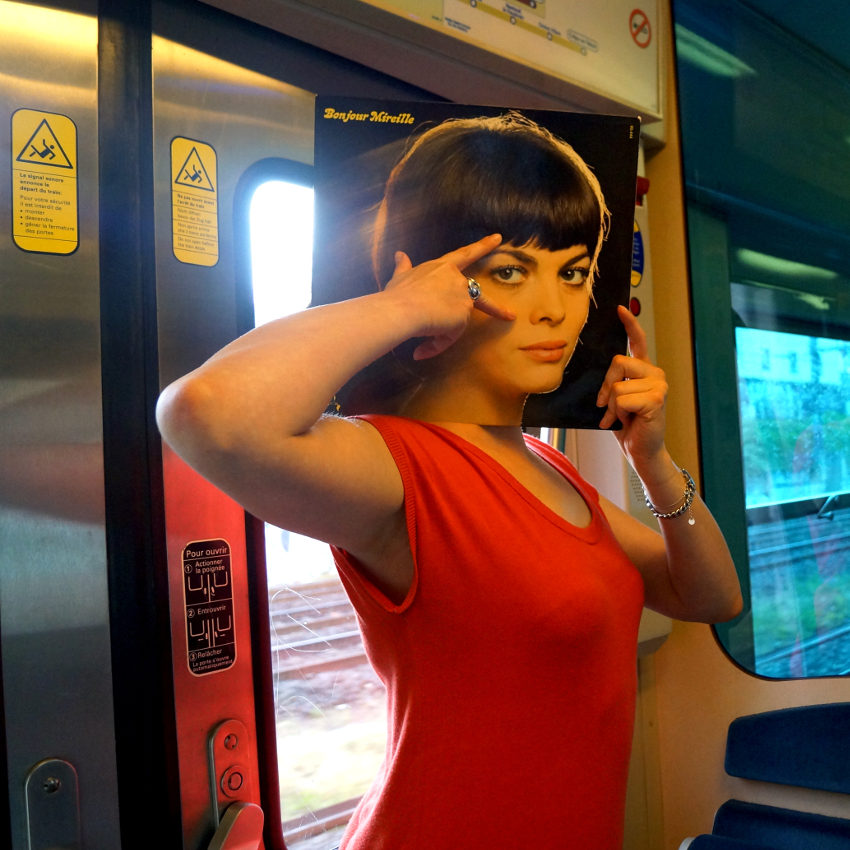
Sleeveface


Sleeveface is defined as "one or more persons obscuring or augmenting any part of their body or bodies with record sleeve(s) causing an illusion."

It is also a participatory photo project on Instagram. People post photos of themselves that were strategically posed with matching album covers expanding the original album cover picture.


Zabriskie Point


Zabriskie Point  is a 1970 American drama film directed by Michelangelo Antonioni about the 1960s counterculture of the United States. Some of the film's most iconic scenes were shot on location at Zabriskie Point in California.

The film was the second of three English-language films that Antonioni did for MGM, but the first shot in the U.S. He had done the successful film Blowup in 1966 a mildly-successful film, The Passenger in 1975. He was best known for his 1959 film L'Avventura.

The film was an overwhelming commercial flop and got almost totally bad reviews. But, like many films, its reputation has improved with age. I saw it when it was released and thought it was nonsensical, but it had interesting cinematography which gets a big boost from the actual desert setting.

The film is available on DVD but rarely shows up at festivals and I've never seen it listed on TV. Does this give it some cult status?

It is an indictment of the American society of the time. One of the two protagonists is Mark. he is a college student who spends more time at protest rallies than isn classes. He carries a gn and tat gets him misidentified as the shooter in a cop killing. He runs away, stealing a small airplane. He meets up with Daria in the california desert and they have sex, travel a bit and pretty much do not much.

I don't know what my take would be on the film if I watched it again today. Have you seen it recently? Give us a mini-review in the comments section.

The Open Theatre of Joe Chaikin as the Lovemakers in Death Valley

I did some digging online and turned up that Harrison Ford has an uncredited role as one of the arrested student demonstrators being held inside a Los Angeles police station.

Co-stars Daria Halprin and Mark Frechette actually did fall in love during production and moved together to the experimental Fort Hill Community. Later, Daria was married to Dennis Hopper for four years. Mark teamed up with three other members of the Fort Hill Community and pulled off a bank robbery in 1973, using a gun without bullets. He went to prison and died there "accidentally."


Zabriskie Point was released a year after Easy Rider and the two are sometimes compared to each other.  Both show the "generation gap" of that decade. They are visually different films with a hippie vibe and eclectic soundtracks. Some critics say that Antonioni took the final scene of Dennis Hopper’s film and decided to make it into a feature film.

Zabriskie Point may have been chosen as a location because it is literally America's lowest point. Antonioni was very critical of the United States and the film certainly shows that.

The film is split between the phony, capitalistic big city, and the bare but beautiful desert.


I can't really recommend the film's music which is sometimes considered to be a "lost" soundtrack. On Amazon you can only get third-party/used versions. If you can get to listen to it - perhaps a borrowed copy and some psychedelics would be preferable -  you'll find some bizarre stuff.  It features The Pink Floyd (with the article "The" intact), The Grateful Dead, Jerry Garcia and Patti Page.

You can find most of these tracks on their original sources, but there are some tracks that were composed specifically for the film. Director Antonioni was attracted to Floyd's Ummagumma album, particularly the track "Careful with That Axe, Eugene."  I'll post a Spotify for it below, but here is a track list from the 2-CD version that restored the lost tracks.

Disc: 1
1. Heart Beat, Pig Meat - The Pink Floyd
2. Brother Mary - The Kaleidoscope
3. Dark Star (Excerpt) - The Grateful Dead
4. Crumbling Land - The Pink Floyd
5. Tennesee Waltz - Patti Page
6. Sugar Babe - The Youngbloods
7. Love Scene - Jerry Garcia
8. I Wish I Was A Single Girl Again - Roscoe Holcomb
9. Mickey's Tune - The Kaleidoscope
10. Dance Of Death - John Fahey
11. Come In Number 51, Your Time Is Up - The Pink Floyd

Disc: 2
1. Love Scene Improvisations-Version 1 - Jerry Garcia
2. Love Scene-Version 2 - Jerry Garcia
3. Love Scene-Version 3 - Jerry Garcia
4. Love Scene-Version 4 - Jerry Garcia
5. Country Song - The Pink Floyd
6. Unknown Song - The Pink Floyd
7. Love Scene-Version 6 - The Pink Floyd
8. Love Scene-Version 4 - The Pink Floyd


The actual location of Zabriskie Point is located east of Death Valley in in California. It has some surreal erosional landscape and is composed of sediments from Furnace Creek Lake, which dried up 5 million years ago, which is long before Death Valley came into existence.

It was named for Christian Brevoort Zabriskie who was a vice president of the Pacific Coast Borax Company which mined borax from that area.

Here is a some trivia about the place.
Philosopher Michel Foucault took an acid trip at Zabriskie Point in 1975 and said it was the greatest experience of his life.
It is shown on the cover of U2's album The Joshua Tree.
It was the location used to represent the surface of Mars in the film Robinson Crusoe on Mars.


Alabama Song (Whisky Bar)


In 1966 the rock group The Doors recorded "Alabama Song (Whisky Bar)" which I always thought was an oddity for the band. (Keyboardist Ray Manzarek plays the marxophone along with the organ and keyboard bass on it.) If I had read the credits closer, I would have discovered that the "Alabama Song" (also known as "Moon of Alabama", "Moon over Alabama", and "Whisky Bar") is an English song written for Bertolt Brecht by his close collaborator Elisabeth Hauptmann in 1925 and set to music by Kurt Weill for the 1927 play Little Mahagonny. If is one of two songs in the play that were English-language parodies written for the play.


The Doors changed the melody and some lyrics such as the verse beginning "Show me the way to the next little dollar..." is omitted. Jim Morrison altered the second verse from "Show us the way to the next pretty boy" to "Show me the way to the next little girl." (Though on the 1967 Live at the Matrix recording, he sings the original "... next pretty boy.")

David Bowie, a Brecht fan, seemed a better fit for the song which he incorporated into his 1978 World Tour and it was issued as a single which reached #23 in the UK. Bowie used the "little boy" line like Morrison, but used Weill's original melody.

Kind of Blue


The soundtrack for your reading...


I borrowed a copy of the anniversary edition of Miles Davis' Kind of Blue from my library. It comes with a documentary DVD and includes copies of Bill Evans's handwritten notes (they became the liner notes). It's nice, but at $75, I can get by just fine with my regular CD edition of the album.

I'm no jazz authority. I can't tell you who played alto sax on a track when I hear it unless I'm looking at the liner notes. I need to read other people's writing to have any background on the album. I probably tend to like more jazz that is closer to the border of pop than hardcore jazz. But Kind of Blue is one album I always liked.

I always borrowed jazz albums first before I bought them. I bought Time Out by The Dave Brubeck Quartet after I had borrowed it from the library a few times. Same thing with A Love Supreme by John Coltrane. Not very radical purchases, but then none of my friends listened to any jazz and definitely didn't buy any jazz records.

I borrowed a bunch of Bill Evans albums to listen to before I bought one. And, like many kids, I really liked Vince Guaraldi's piano on that Charlie Brown Christmas soundtrack.


In 1958, Davis added Bill Evans to his band. Evans was a classically-trained pianist and I think that changed Davis' sound. (Don't ask me to explain modal jazz, but that's what people talk about about here.)  Evans left later that year and was replaced by Wynton Kelly.

Spring 1959: Davis was in the studio with a sextet to record what became Kind of Blue and he calls back Evans for the sessions because his piano style was key to the sound. (Kelly played only on "Freddie Freeloader.")

Kind of Blue was/is the best-selling jazz album of all time.

The anniversary set made me reread Bill Evans' liner notes. (Do you miss liner notes and 12" record album covers? I do.)

"There is a Japanese visual art in which the artist is forced to be spontaneous. He must paint on a thin stretched parchment with a special brush and black water paint in such a way that an unnatural or interrupted stroke will destroy the line or break through the parchment. Erasures or changes are impossible. These artists must practice a particular discipline, that of allowing the idea to express itself in communication with their hands in such a direct way that deliberation cannot interfere.

The resulting pictures lack the complex composition and textures of ordinary painting, but it is said that those who see well find something captured that escapes explanation.

This conviction that direct deed is the most meaningful of reflections, I believe, has prompted the evolution of the extremely severe and unique disciplines of the jazz or improvising musician.

Group improvisation is a further challenge. Aside from the weighty technical problem of collective coherent thinking, there is the very human, even social need for sympathy from all members to bend for the common result. This most difficult problem, I think, is beautifully met and solved on this recording. As the painter needs his framework of parchment, the improvising musical group needs its framework in time. Miles Davis presents here frameworks which are exquisite in their simplicity and yet contain all that is necessary to stimulate performance with sure reference to the primary conception.


Miles conceived these settings only hours before the recording dates and arrived with sketches which indicated to the group what was to be played. Therefore, you will hear something close to pure spontaneity in these performances. The group had never played these pieces prior to the recordings and I think without exception the first complete performance of each was a take.

Kind of a zen (small z) thing going on there.

That painting might actually be shodo (calligraphy), but I think he meant brush painting ( sumi-e). That's something I have tried myself.

I try not to lift the brush until the end of the line. No strokes like you're used to in oil paint. No going back over the line.

Calligraphers can sometimes do the whole word in one flowing move.

That lack of complexity can be very freeing.

On this album, that simplicity is what I really like, especially compared to other Miles Davis albums like Bitches Brew which I will freely admit that I don't get.

From what I've read, Miles Davis was not a nice man. If you can separate the work from the man, then it's easier to appreciate the music. That's all I'm writing about here - the music.

One little Davis story that I can appreciate is that in 1964 Jackie DeShannon urged him to use his influence at Columbia Records to get a rock band a contract. He did and that band was The Byrds. Thanks, Miles.