Services

Showing posts with label literature. Show all posts

The Epic of Gilgamesh

One of the earliest known poems in human history is the Epic of Gilgamesh, which originated in ancient Mesopotamia around 2100 BCE. 

This epic poem (author unknown) recounts the adventures and exploits of Gilgamesh, a legendary king of the Sumerian city-state of Uruk. 

The poem is composed in ancient Sumerian and Akkadian languages and is one of the earliest works of literature known to humanity. It predates many other ancient literary works, including the Homeric epics of Greece (such as the Iliad and the Odyssey) and the ancient Indian epics (such as the Ramayana and the Mahabharata). 

It consists of various episodes and narratives, including Gilgamesh's quest for immortality and his friendship with Enkidu, a wild man created by the gods.

I read Gilgamesh in college where it was presented as both a poem and a discovery that provided valuable insights into the culture, beliefs, and storytelling traditions of ancient Mesopotamia. It remains a significant literary and historical artifact, showcasing the enduring power of storytelling and poetry throughout human civilization.


Neo-Assyrian clay tablet. Epic of Gilgamesh, Tablet 11: Story of the Flood.
Known as the "Flood Tablet"
From the Library of Ashurbanipal, 7th century BC


The Once and Future King

Arthur, the Lady of the Lake with Excalibur - by Andrew Lang
 (from The Book of Romance by Henry Justice Ford, 1903)

For a long time, some Britons believed that King Arthur would return when they needed him. Okay, that sounds ridiculous to expect a fictional or legendary person to come to your aid, but the legend was once very strong in the culture.

What would bring King Arthur back? It was said that he would return when Britain needed him. A lack of chivalry? A weakening of democracy? Divisions in the United Kingdom? Or would it be from the darker parts of the Arthurian legends: deception, false loyalty? Maybe it would be the eventual healing of the kingdom.

Some of my recent reading and movie watching has brought King Arthur back into my thoughts at this year end.

I wrote elsewhere about how the once and future King appears in different centuries in our interpretations of his story. The recent death of Queen Elizabeth and King Charles III put the royals back in the public eye, even in America.

Charles I did not have a good end. He was beheaded for treason on January 30, 1649. He had ascended to the English throne in 1625 following the death of his father, King James I. He offended his Protestant subjects by marrying a Catholic French princess, responded to political opposition to his rule by dissolving Parliament several times and after deciding to rule without Parliament the struggle between king and Parliament led to the outbreak of the first English civil war. Not exactly a uniting monarch.

Charles II was King of Scotland from 1649 until 1651, and King of England, Scotland and Ireland from the 1660 Restoration of the monarchy until his death in 1685. Charles II had no legitimate children and his subjects were not happy with the prospect of his Roman Catholic brother James succeeding him. Charles died after a stroke in 1685 with the problem still unresolved and James became King James II and VII.


In T.H. White's retelling of the Arthur story, a boy is tutored by  Merlyn to prepare him for what the wizard knows is coming. Merlyn can see the future and sees the great Knights of the Round Table, the love of a queen, chivalry, and also deceit and Arthur becoming King of the Britons. He will bring the kingdom of Camelot from the Dark Ages into Enlightenment. 

While the knights of the Round Table were off on many a noble quest, the forbidden love between Queen Guenever and Lancelot, and the plotting of Arthur’s half-sister Morgana would threaten the kingdom. Morgana raises her son Mordred to hate his uncle Arthur. 

It is a strange woman, the Lady of the Lake, who gives Arthur his magical sword, Excalibur. In Le Morte d'Arthur, Morgana steals Excalibur and gives it to her lover, Accolon, intending that they overthrow King Arthur and rule in his place. 

Arthur is able to recover the sword, but she steals its scabbard, which has healing properties. That missing part will contribute to Arthur’s fatal wounding in his final battle.

I took a course in the Arthurian legends in college and we looked at what historical facts may have contributed to the legends. He would have been in southern Britain, around Wales and Cornwall, in the 5th century A.D. That was not so far in time from when the Romans left in A.D. 410. 

Britannia was actually in a period of peace and prosperity under Roman occupation, but when they left warlords battled for control. Without a central government, the island was open to conquest by the seafaring Saxons. History and legend mix and in the Battle of Badon (A.D. 500), it was said that Arthur killed almost a thousand Saxons. 

A Welsh poem, "Y Gododdin," is a series of elegies to the men of the Brittonic kingdom of Gododdin. One stanza mentions King Arthur in passing, which would make it the earliest known reference to that character. The poem was probably composed around the year 638, which was barely a hundred years after Arthur’s supposed death. But the only surviving copy of the poem is a transcription made six centuries later, so it is unclear if Arthur was in the original or added later.

King Aragorn
 (as portrayed by Viggo Mortensen in the films)

This article's title does not refer to The Return of the King, the third and final volume of J. R. R. Tolkien's The Lord of the Rings, which follows The Fellowship of the Ring and The Two Towers, but comparing King Aragorn and his return to Arthur has some legitimate points. 

After defeating Sauron's forces in Gondor by leading an army of Gondor and Rohan against the Black Gate of Mordor, he distracted Sauron's attention and enabled Frodo Baggins and Samwise Gamgee to destroy the One Ring. Aragorn was acclaimed as King by the people of Gondor, and crowned King of both Gondor and Arnor.

The earliest tales of Arthur make him a less Romantic figure and more of a warrior and dux bellorum (war chief). Arthur as king comes later with Geoffrey of Monmouth’s History of the Kings of Britain from the year 1138. In this, Arthur is king and Guinevere, Merlin, Excalibur, and other familiar names appear. Not many people, even at that time, took Geoffrey’s History, as true and accurate "history." From Herodotus to Geoffrey, fact and legend crossed over each other if it improved the narrative. 

French and English writers soon after added their own versions and tales. The quest for the Holy Grail, the Green Knight and older tales that were not partof Arthur's story - such as that of Tristan and Iseult - were incorporated into the Arthurian tales.

My Professor Kellogg went on summer expeditions in search of Arthurian evidence. British archaeologist Nowell Myres devoted 50 years to the search. Frustrated, he wrote near the end of his life that “no figure on the borderline of history and mythology has wasted more of the historian’s time.” Some modern scholars propose that though Arthur himself was not a historical person, his legend may have been inspired by at least one real person. I found possible candidates included Artúr mac Áedán, a prince of a 5th-century Gaelic kingdom in Scotland, and Lucius Artorius Castus, an Etruscan-born Roman cavalryman who occupied Britannia in the 2nd century. the similarity of names seems to be a big factor in those possibilities. The 5th-century Romano-British military commander Riothamus is another possible Arthur. He is mentioned in Roman histories as leading a war party in Brittany, the Celtic province in the north of France, supporting Roman troops in a campaign against the Goths around the year 470. The Gothic historian Jordanes called Riothamus “King of the Britons,” in 551.

In that course I took, we were reading mostly Malory's Le Morte D’Arthur in its 15th-century Middle English but also some of Monmouth’s History and Chrétien de Troyes, a French medieval poet, who wrote a series of Arthurian romances – such as Lancelot and Perceval. I read for an assignment a version of the German Wolfram Von Eschenbach's Parzival. 

Sir Thomas Malory’s prose tales of King Arthur, Guinevere, Lancelot, Merlin, and the Knights of the Round Table were written while he was in prison and he is credited with compiling and modifying from French and English sources to make a complete story of Arthur’s life. 

I was fascinated by books and movies about the legend of King Arthur as a boy. It hasn't really left me. 

One thing that Professor Kellogg told us was that Arthur’s story has been reinterpreted many times in the centuries since Malory. Each interpretation and reimagining of the legend reflects the time the new author lived in and Arthur is seen in a different way, reflecting the time of the reinterpretation. For example, the love triangle of Arthur, Guinevere and Lancelot has been portrayed in ways so that each of them is to blame. Arthur is at fault. Arthur is a fool. Arthur is loyal to his friend and wife.

I reread the book recently in a newer version by Gerald Davis which uses both the Caxton and the older Winchester manuscripts.  

And I have watched many movies and TV programs and read other books. When I read about young Arthur, I can't help but see the Disney cartoon young Arthur of The Sword in the Stone that I saw when I was 10 years old and also the Arthur in the sourcebook by T.H. White, The Once and Future King, which I read when I was in high school. Excellent book.Fun movie.

I also think about how Professor Kellogg compared Arthur to Jesus Christ. the professor believed in a historical Jesus but felt that legends had been built around his core story in the years after his death. He also thought that the return of Arthur was not unlike the idea of the return of Jesus in "our greatest time of need."

Versions of the legend during the period of WWII saw Arthur as returning in some form to save England.

Some people compare the illicit affairs around Diana and the now King Charles II to a version of the Arthur/Guinevere/Lancelot triangle.  

In the film, Excalibur, (which I watched multiple times with my young sons) director John Boorman took a mythological and allegorical approach to the story.  Arthur is the Wounded King who can only be healed (along with his kingdom) by the Holy Grail. It is the cycle of birth, life, decay, and restoration. That idea is echoed in another film I just rewatched. The 1991 film, The Fisher King, starring Jeff Bridges and Robin Williams puts in our time the Fisher-Wounded-Sinner King's realm becomes a wasteland. 

It is not Arthur or Lancelot who finds the Grail, because both of them are flawed and unworthy. The healing Grail is found by Perceval.

John Boorman remarked that the Christian symbolism of the Grail is what “my story is about: the coming of Christian man and the disappearance of the old religions which are represented by Merlin. The forces of superstition and magic are swallowed up into the unconscious.”

Will Arthur return? rather impossible if he never actually existed. Will some new Arthur rise up? That is yet to be determined.

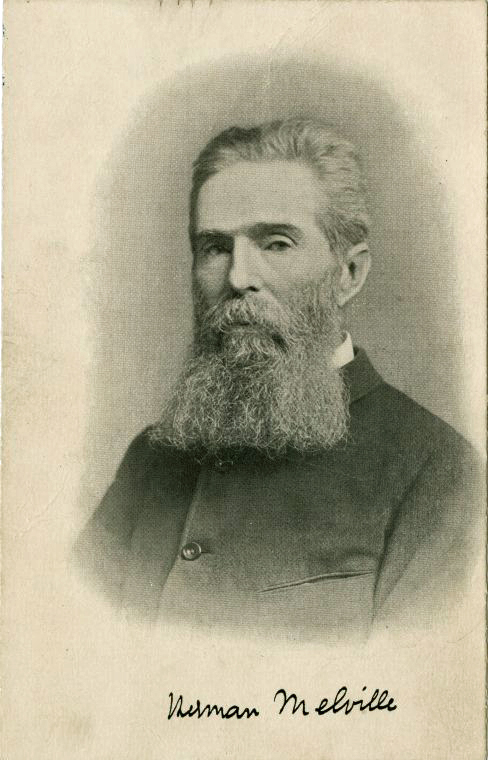
Herman Melville Sets Sail

 "A whale ship was my Yale College and my Harvard." - Herman Melville

The last known image of Melville, 1885

The Writer's Almanac reminds me that on this day - January 2 - in 1841, Herman Melville set sail on the whaler Acushnet from New Bedford, Massachusetts.

Herman Melville was born into an affluent family that had fallen on hard financial times. Becoming a whaler was not on his life plan, but after the death of his father and a fire that wiped out his brother's business, Herman had to leave school to work.

A New Yorker, he tried a variety of things: a job at a bank, less than a month as a lowly merchant mariner (called a "boy") on a voyage to England and back, farming out West, teaching and then again to take to the sea.

In 1841, he went to the whaling port of New Bedford, Massachusetts. He had little experience at sea and no experience at whaling but he was taken on in a lower position on the new whaling ship Acushnet. It was a 359-ton ship with two decks and three masts. It was headed to the Pacific Ocean.

Whaling was lucrative for the owners who sold the prized oil for a high price, but also sold the teeth and bones.  Whale oil reigned supreme until 1859 when petroleum was discovered in Pennsylvania. The oil hat came from melting down whale blubber was fuel for household lamps, streetlights, and even lighthouses, and it was one of the most popular lubricants, used in factory machines, sewing machines, and clocks.

Melville would later write about whaling in Moby-Dick, or The Whale and made it sound accurately dangerous and adventurous. He would be in the last generation of men who hunted whales by hand using harpoons up close.

The sperm whale was the preferred target and they could weigh up to 60 tons and grow up to 60 feet long and swam at a speed of 20 knots. They were known to have killed men and destroyed ships during a hunt.

His first whale hunt was off the coast of Brazil in March of 1841. Melville ultimately spent four years at sea and much of his writing would come from that time. He would not have been at first one of the men in the smaller whaleboats that chased and harpooned a whale. But he would have observed that and seen a harpooned whale take the small boat for a "Nantucket sleigh ride" as they continued to harpoon and tire the whale until the dead whale could be towed to the ship. He would have been involved in the laborious and extremely messy process of skinning it on deck.

Melville and shipmate Richard Greene would desert the Acushnet in July 1842 in the Marquesas Islands. Greene would become "Toby" in Melville's first book, Typee. about their time there.

 Scrimshaw whaling scene carved by a Nantucket whaler, Edward Burdett.
Burdett was a deck officer who died at the age of 27 when a harpoon line
caught around his feet and dragged him overboard to drown in the ocean.

Though we know of his whaling days mostly from Moby-Dick, Melville also wrote about his years at sea in other books. Typee and Omoo were about his time in Polynesia after he had jumped ship. His fourth book, Redburn: His First Voyage, is about being a merchant mariner out of Liverpool, England. It is actually funny in parts and quite different from the heavier Mardi (1848). His time in the U.S. Navy is recounted in White-Jacket (his fifth book)

Though these five books established him as a writer, their sales were not great. The best-selling were the first two tales of the islands and sales dropped with each new book. His sixth book would be the novel is known for but that had poor sales and reviews when it was published.

Along with his own experiences at sea and whaling, Melville was inspired by a number of other books, both fiction and non-fiction. Richard Henry Dana Jr.'s new novel, Two Years Before the Mast and meeting William Henry Chase, the son of Owen Chase, who gave him a copy of his father's account of his adventures aboard the ship Essex and its encounter with a sperm whale are clear influences. An account published in 1839 in an issue of The Knickerbocker magazine of the hunt for a great white sperm whale named Mocha Dick not only influenced Melville to sign on to the Acushnet, but clearly figured into his own novel. Moby-Dick is a novel with inter-chapters that are largely non-fiction about whales and whaling.

The novel sold poorly and Melville would never again be well reviewed in his lifetime and forced to find work other than being a writer in order to pay the bills.

His real fame would come after his death. Though he had trouble publishing his writing after Moby-Dick, modern readers and critics would praise this later work, including stories such as Bartleby the Scrivener, Billy Budd and The Confidence Man. Today, Moby-Dick is considered a very ambitious and great novel though sadly Melville would never know that and never benefit from its continued sales and study.


The Curious Case of an Animated 1001 Nights

Woodcut illustration from A Thousand and One Nights by Friedrich Gross, 1830

A friend told me about A Thousand and One Nights a Japanese 1969 adult anime feature film directed by Eiichi Yamamoto. The film was a hit in Japan but given limited screenings in America in 1970. As an X-rated animated film, it did not seem to appeal to an American audience in 1969.

The dubbed version of the film is now very rare, and has never been released on home video, and may be considered lost.

An English-dubbed version was cut to 100 minutes. The film predates the more successful release of Fritz the Cat, the first American X-rated animated film, by three years.


Having read the classic anonymous Tales from the Thousand and One Nights in college, I can only imagine what the filmmakers might have depicted based on some of the more erotic scenes.

This is NOT Disney’s story of Aladdin. In fact, Aladdin is not part of the original Arabic text. Still, it is one of the best-known tales in One Thousand and One Nights (AKA The Arabian Nights) though it was added to the collection in the 18th century by the Frenchman Antoine Galland, who acquired the tale from a Syrian Maronite storyteller named Hanna Diyab. "Aladdin and the Magic Lamp" is one of the best known and most retold of all fairy tales.

Has anyone seen the film or know where it’s available? I can't find it, but I did find the original Japanese trailer for the film which I originally tried to post on my Tumblr site - but it was blocked. It's curious because I would hardly consider the trailer to be X-rated and I know that Tumblr still has far more X-rated and clearly pornographic images. That is despite their admirable attempts to clean up their image. Their algorithms for doing so really suck.


Opening Lines and Last Lines of Novels: A Quiz


If you have not read MOBY-DICK (1851) by Herman Melville, you may still recognize the opening line: ''Call me Ishmael.'  It is one of the most famous opening lines in literature.

Sometimes there is a clue to the book in a opening line, such as with ''You don't know about me without you have read a book by the name of The Adventures of Tom Sawyer, but that ain't no matter.''  That is the opening of THE ADVENTURES OF HUCKLEBERRY FINN (1885), the "sequel" written by Mark Twain.

When I first read ''If you really want to hear about it, the first thing you'll probably want to know is where I was born, and what my lousy childhood was like, and how my parents were occupied and all before they had me, and all that David Copperfield kind of crap, but I don't feel like going into it, if you want to know the truth,'' I knew that I would like THE CATCHER IN THE RYE (1951) by J.D. Salinger.

A RIVER RUNS THROUGH IT (1989) by Norman Maclean, opens with ''In our family, there was no clear line between religion and fly-fishing.''


A TALE OF TWO CITIES (1859) by Charles Dickens holds the distinction of having both a memorable (and long) opening sentence - ''It was the best of times, it was the worst of times, it was the age of wisdom, it was the age of foolishness, it was the epoch of belief, it was the epoch of incredulity, it was the season of Light, it was the season of Darkness, it was the spring of hope, it was the winter of despair" - and also an often quoted and remembered closing sentence - “It is a far, far better thing that I do, than I have ever done; it is a far, far better rest that I go to than I have ever known.”

Do you have a favorite opening or closing line from a novel? Let us know in a comment below.

Try out your literary knowledge with these old and new novel closers. It is a pretty tough 20-questions quiz with only a few clues.  Answers at the bottom.

  1. ''It was a queer, sultry summer, the summer they electrocuted the Rosenbergs, and I didn't know what I was doing in New York.''  
  2. ''It is a truth universally acknowledged that a single man in possession of a good fortune must be in want of a wife.''
  3. “I am haunted by waters.”
  4. “It is not often that someone comes along who is a true friend and a good writer." 
  5. “‘Well, I’m back,’ he said.” 
  6. “Isn’t it pretty to think so?’”
  7. “All was well.”
  8. “But there are much worse games to play.”
  9. “All their life in this world and all their adventures had only been the cover and the title page: now at last they were beginning Chapter One of the Great Story which no one on earth has read: which goes on forever: in which every chapter is better than the one before.”
  10. “Are there any questions?”
  11. “Don’t ever tell anybody anything. If you do, you start missing everybody.”
  12. “The old man was dreaming about the lions.”
  13. “Tomorrow is another day.”
  14. “One bird said to Billy Pilgrim, 'Poo-tee-weet?’”
  15. “He would be there all night, and he would be there when Jem waked up in the morning.”
  16. “When I stepped out into the bright sunlight from the darkness of the movie house, I had only two of things in my mind: Paul Newman and a ride home…”
  17. “He loved Big Brother.”
  18. “So we beat on, boats against the current, borne back ceaselessly into the past.”
  19. “I am haunted by humans.”
  20. “I lingered round them, under that benign sky; watched the moths fluttering among the heath, and hare-bells; listened to the soft wind breathing through the grass; and wondered how any one could ever imagine unquiet slumbers for the sleepers in that quiet earth.”


  1. The Bell Jar, Sylvia Plath 
  2. Pride and Prejudice, Jane Austen
  3. A River Runs Through It by Norman Maclean
  4. Charlotte’s Web by E.B. White
  5. The Return of the King by J.R.R. Tolkien
  6. The Sun Also Rises by Ernest Hemingway
  7. Harry Potter and the Deathly Hallows by J.K. Rowling
  8. Mockingjay by Suzanne Collins
  9. The Last Battle by C.S. Lewis
  10. The Handmaid’s Tale by Margaret Atwood
  11. The Catcher in the Rye by J.D. Salinger
  12. The Old Man and the Sea by Ernest Hemingway
  13. Gone with the Wind by Margaret Mitchell
  14. Slaughterhouse-Five by Kurt Vonnegut
  15. To Kill a Mockingbird by Harper Lee
  16. The Outsiders by S.E. Hinton
  17. Nineteen Eighty-Four by George Orwell
  18. The Great Gatsby by F. Scott Fitzgerald
  19. The Book Thief by Markus Zusak
  20. Wuthering Heights by Emily Brontë

Long Literary Sentences

What is the longest sentence in literature?

One of the longest sentences in literature is certainly in William Faulkner's Absalom, Absalom! (1936). That sentence is composed of 1,288 words and is Quentin Compson’s silent thoughts.

“There was a wisteria vine blooming for the second time that summer on a wooden trellis before one window, into which sparrows came now and then in random gusts, making a dry vivid dusty sound before going away: and opposite Quentin, Miss Coldfield in the eternal black which she had worn for forty-three years now, whether for sister, father, or nothusband none knew, sitting so bolt upright in the straight hard chair that was so tall for her that her legs hung straight and rigid as if she had iron shinbones and ankles, clear of the floor with that air of impotent and static rage like children’s feet, and talking in that grim haggard amazed voice until at last listening would renege and hearing-sense self-confound and the long-dead object of her impotent yet indomitable frustration would appear, as though by outraged recapitulation evoked, quiet inattentive and harmless, out of the biding and dreamy and victorious dust.” — Absalom, Absalom! by William Faulkner

Molly Bloom's soliloquy in the James Joyce novel Ulysses (1922) is also a consideration at 3,687 words, but I knock this one out because it really is just a bunch of sentences without punctuation. Joyce was known for "stream of consciousness," which was quite a popular stylistic device in the 1920s and 30s. It made those run-on sentences that your English teacher marked you down for on compositions legitimate. At least, that was the line I used on my tenth-grade English teacher, Mr. Reece, who replied that "Those writers know the rules, so now they can break them."

Victor Hugo has a nice 800-plus line in Les Misérables.

John Updike was very careful with his sentences, but he used a few unusually long ones across his many novels. Here's an example from Rabbit, Run.
“But then they were married (she felt awful about being pregnant before but Harry had been talking about marriage for a while and anyway laughed when she told him in early February about missing her period and said Great she was terribly frightened and he said Great and lifted her put his arms around under her bottom and lifted her like you would a child he could be so wonderful when you didn’t expect it in a way it seemed important that you didn’t expect it there was so much nice in him she couldn’t explain to anybody she had been so frightened about being pregnant and he made her be proud) they were married after her missing her second period in March and she was still little clumsy dark-complected Janice Springer and her husband was a conceited lunk who wasn’t good for anything in the world Daddy said and the feeling of being alone would melt a little with a little drink.”

In Jamaica Kincaid’s “The Letter from Home,” she has a long one full of commas. I can see why she wants it to run fast as a sentence, but you could easily make some of the commas into periods and it would work just as well.
"I milked the cows, I churned the butter, I stored the cheese, I baked the bread, I brewed the tea, I washed the clothes, I dressed the children; the cat meowed, the dog barked, the horse neighed, the mouse squeaked, the fly buzzed, the goldfish living in a bowl stretched its jaws; the door banged shut, the stairs creaked, the fridge hummed, the curtains billowed up, the pot boiled, the gas hissed through the stove, the tree branches heavy with snow crashed against the roof; my heart beat loudly thud! thud!, tiny beads of water grew folds, I shed my skin…"
This extremely long sentence became a kind of literary game. Two examples that seem more like a gimmick to me.

Jonathan Coe’s The Rotter’s Club ends with a 33-page-long, 13,955-word sentence.

French writer Mathias Énard has a one-sentence novel, Zone, that is 517 pages long with only 23 chapter breaks to help you avoid going completely insane while reading.


Gulliver Amongst the Yahoos


Gulliver's Travels illustration by James Gilray, using George III as the King of Brobdingnag
and a General Napoleon in the role of "Gulliver"

Gulliver's Travels is a prose satire and the best known writing of Irish writer and clergyman Jonathan Swift. It is a book I never read all the way through and I suspect I am not the only reader in that position. It's not that the book is terrible, but it is tough reading, in a vocabulary unlike ours today and in a style also unlike today.

Even its full title is ponderous: Travels into Several Remote Nations of the World. In Four Parts. By Lemuel Gulliver, First a Surgeon, and then a Captain of Several Ships. Published in 1726, a long title of explanation was not unusual - not unlike today's titles for non-fiction books and academic papers which almost always have a good title, a colon, and an explanation.

Swift's book is one of those classics that is well known but unread. It is a satire on human nature, politics and the genre of travelers' tales that were popular at the time.

Swift claimed that he wrote the book "To vex the world rather than divert it."

November 30 is Swift's birthday. I imagine that if he were here to celebrate, he would be disappointed that his book is not popular reading, but pleased that it is a "classic" that is still in print. I think he would be amused by the many adaptations for the screen that have been made. And I think he would find much of our current society the stuff of satire.

Gulliver travels on four voyages. He finds exotic places and meets strange creatures. The scenes most people recall are his meeting with the race of miniature people in Lilliput and, on another voyage, a race of giants in Brobdingnab. The latter place is located on the western coast of the North America.

Laputa


One of his interesting visits is when he is rescued by the people of the flying island of Laputa. It seems quite sophisticated as it is a kingdom devoted to the arts of music, mathematics and astronomy. Unfortunately, they seem unable to use their knowledge for any practical purposes.

Laputa rules the land below by bombing them with rocks when necessary. At the "Royal Society" kind of Grand Academy of Lagado, they research idiotic things quite seriously: extracting sunbeams from cucumbers, softening marble to use in pillows and mixing paint by smell.

One piece of research done there that might actually be useful in our current political climate of conspiracies is examining the excrement of suspicious persons. This "muckraking" could possibly be a useful tool for today's investigative journalists.

The only version of Gulliver I read cover-to-cover

The most disgusting race of beings he encounters are called Yahoos. Gulliver eventually realizes that they are actually the humans like himself.


Here is the Gulliver's Travels in an American animated feature film version made in 1939 by Fleischer Studios. It is based very loosely on only the Lilliput and Blefuscu lands Gulliver finds in his first voyage.

Paramount Pictures wanted a feature-length animated film as a response to Disney's groundbreaking first cel-animation film, Snow White and the Seven Dwarfs, which was a big hit. Gulliver's Travels was the second animated feature film produced by an American studio.


Drinking Your Way Through Hemingway's Fiction

Ernest Hemingway at the Finca Vigia, Cuba 1946

Alcoholic drinks and Ernest Hemingway go together in his life and his writing. What did Papa actually drink in real life? You'd think with his tough guy image there would be a lot of whiskey and beer, but he had a penchant for cocktails. Despite what they may have you think at Sloppy Joe's in Key West, he didn't like a mojito or sweet drinks. He did like daiquiris, at least during his Islands in the Stream period. Supposedly, he downed 17 in one sitting at the El Floridita in Cuba.

You could write a bartender's guide to hsi drinks - and someone did. To Have and Have Another: A Hemingway Cocktail Companion (playing off of Papa's novel To Have and Have Not which was made into a film with Humphrey Bogart and Lauren Bacall) is a kind of mixing manual for for Hemingway enthusiasts who might want to drink their way through his fiction along with the characters.

While reading Islands in the Stream, you can try the two recipes included for the Floridita's "E. Henmiway (sic) Special" and the "Papa Doble." Both are daiquiris minus the sugar. Thomas Hudson in that book also likes a gumlet.

Frederic in A Farewell to Arms liked a "civilized" martini. (1 3/4 oz. Gordon's gin to 1/8 oz. Noilly Prat vermouth)

In the Sun Also Rises, Jake goes with a Calvados-and-gin combo called a Jack Rose.

Nick Adam in the short stories like "Three Day Blow" drinks plain old whiskey, which, according to the guide, is probably scotch. Scotch and soda was a favorite of Hemingway. Bourbon doesn't show up in the fiction but EH drank some Old Forester in real life. Author Greene speculates that he "decided to leave bourbon to Faulkner."

There are plenty of boozy myths about Hemingway's drinking. Hemingway did not invent the Bloody Mary, though a story persists that it was a drink he favored because it hid the booze from "that bloody wife, Mary,'

And he liked the un-Hemingwayish White Lady (gin, Cointreau, lemon juice) and champagne and champagne cocktails (scotch & champagne).


The book is full of background on the various drinks, ingredients, their histories and the fictional or characters connected to them.

On this cold, winter day, I might just go on an armchair gondola ride in Venice with my imagined Italian countess and sip a few Negronis while rereading Across The River And Into The TreesAs straightforward as a Hemingway sentence - one part gin, one part sweet vermouth, and one part Campari, stir, and serve over ice.

The Speculative Neal Stephenson

I am not a hardcore science-fiction/fantasy reader. But there are a few authors that I follow. One is Neal Stephenson.

Sometimes he is pegged as a sci-fi writer - but he is also considered a writer of speculative fiction (a term I prefer for him), historical fiction, maximalism, cyberpunk, and post-cyberpunk.

His books include mathematics, cryptography, philosophy, currency, and the history of science.

He also writes non-fiction articles about technology in publications such as Wired Magazine.

According to his bio, he has worked part-time as an advisor for Blue Origin, a company funded by Jeff Bezos that is developing a manned sub-orbital launch system.

He has a book that I read slowly, creating my own installments over the course of about six months and that have finally finished titled Anathem, which is his ninth novel.

In it, he creates his own inverted world and a new language.

There are several videos on Amazon where you can hear him introduce and read some of it.

Set on a planet called Arbe (pronounced "arb"), Anathem is a world divided into two cultures. The saecular general population seems like "us" shopping in megastores, and destroying the the environment. The others are the highly-educated avaunt who live a monastic life filled by by intellectual activity and ritual.

The avaunt view time differently from their walled-off areas that are built around giant clocks designed to last for centuries. The avaunt are separated into four groups, depending on the amount of time they are isolated from the outside world and each other - from 1 year to the Millennarians,very wise people who only emerge in years ending in 000.

Living in two worlds is something that runs through most of the books of his that I have read.


Neal Stephenson was born in 1959 in Fort Meade, Maryland. His father taught electrical engineering, his grandfather taught physics and his mother was a biochemistry researcher.

He was a self-described theater geek.
"I played the role of Mephistopheles in Christopher Marlowe's Doctor Faustus and on the technical side made a full-size mechanical Kong hand that, at one point in the play, reaches through a window and drags somebody offstage."


The family moved to Ames, Iowa in 1966 where he graduated from high school in 1977. He attended Boston University, first majoring in physics, then switching to geography because it allowed him more time to use the university's mainframe computer. He graduated in 1981 with a B.A. in geography with a minor in physics. He moved to Seattle with his wife, Ellen, who did her medical residency there.

Stephenson says Anathem was inspired by the real-life Millennium Clock, a project thought up by inventor Danny Hillis and developed by the Long Now Foundation. The clock is built to last 10,000 years. In our age of things go ever faster, the Millennium Clock would only tick once a year, chime once a century, and the cuckoo would appear once a millennium.

The first book of Stephenson's that I and many others discovered was Snow Crash, in which he postulated the Metaverse - a digital alternative virtual world. It was an idea that caught the attention of cyberpunk readers back in 1992. Computer scientists creating the early virtual worlds have used his metaverse as a kind of blueprint. Salon.com called him the "poet laureate of hacker culture."

"I was sort of going for broke with Snow Crash. I had tried to write stuff that was more conventional and that would be appealing to a large audience, and it didn't work. I figured I would just go for broke, write something really weird, and not be so worried about whether it was a good career move or not."

In the book's "real" world, Hiro Protagonist just delivers pizza, but in the Metaverse, he is a warrior prince.

Snow Crash and his next four books were all on the New York Times best-seller list. I haven't read all of his books and I avoid books in a series - though I realize that series like Game of Thrones and others are very big publishing (and TV and movie) success stories. (I did read all the Harry Potter books.)

The Diamond Age is set in a near-future Shanghai and features a woman who owns an ususual nanotech book.

Cryptonomicon delves into cryptography.

And one of his multi-volume series is in the steampunk genre. Quicksilver is the the first volume of the "Baroque Cycle."