Services

Showing posts with label writing. Show all posts

Anne Frank Revises Her Diary from the Secret Annex

In the early part of 1944, Anne Frank decided to rewrite her diary as an autobiography. She had been writing for two years. Her parents had given her a red-and-white-checkered diary as a 13th birthday present and it was just a few weeks later that her sister, Margot, received a notice to report for a forced labor camp. 

The family went into hiding the next day. They moved into rooms above the business office of Otto Frank, Anne’s father. This always seemed to me to be a dangerous place to hide as it seemed an obvious place to look for the family. They also brought Otto’s business partner his wife and son, and a dentist. 

Anne recorded her daily thoughts in the diary which she nicknamed “Kitty” and when she had filled it she used a black-covered exercise book. That had been brought by some non-Jewish friends who gave food and supplies to the families in hiding. 


On March 28, 1944, they were listening on a contraband radio and heard a broadcast by the Dutch Government in Exile (from London). The Education Minister encouraged ordinary Dutch citizens living under the Nazi occupation to preserve documents for future generations. The next day Anne wrote in her diary:

“Of course, they all made a rush at my diary immediately. Just imagine how interesting it would be if I were to publish a romance of the ‘Secret Annex,’ the title alone would be enough to make people think it was a detective story. But, seriously, it would be quite funny 10 years after the war if people were told how we Jews lived and what we ate and talked about here.”

I always after I read her published diary that she was a very polished teen writer. I didn't know that she went back through two years of entries and rewrote them. She even gave pseudonyms to her family and the others in the Secret Annex.

She made plans to write after the war a memoir called Het Achterhuis (“the house behind,” or “the annex”) and would use the diary as its basis. She wrote that “I know that I can write, a couple of my stories are good, my descriptions of the ‘Secret Annex’ are humorous, there’s a lot in my diary that speaks, but whether I have real talent remains to be seen.” 

Anne wanted to become a published writer, either as a journalist or novelist. She had her doubts that she was a good enough writer.  "... sometimes I very much doubt whether anyone in the future will be interested in all my tosh. ‘The Unbosomings of an Ugly Duckling’ will be the title of all this nonsense.”

In the spring and summer of 1944, she wrote more than 300 pages of loose paper with her revised work and was still working on it when the Nazis raided the secret annex in August of 1944.

Everyone was sent to concentration camps. Anne probably died of typhus in Bergen-Belsen concentration camp in 1945. Of the eight members of the secret annex, only Anne’s father, Otto Frank, survived.

Miep Gies was one of the people who helped those hiding in the Secret Annex. Gies found Anne’s writing and kept it in her desk, hoping to return it to Anne one day. When she learned that Anne had died she passed it on to Otto, who further edited it and published Anne’s story in 1947.

I read the diary when I was 13 and only recently reread The Diary of a Young Girl: The Definitive Edition which was published 50 years after the original edition. This new edition has diary entries restored that were omitted from the original edition. It comes to a significant thirty percent more material. The restored entries that her father had edited out are ones that perhaps embarrassed him and made Anne seem "purer." But after all, she was a teenage girl who wrote about her sexuality, argued with her parents and tipped between the little girl and young woman. 


(A revised version of this post and more thoughts about Anne are at https://paradelle.wordpress.com/tag/anne-frank/)


Man Pursuing the Horizon: Stephen Crane

I have been a longtime reader and fan of novelist and short-story writer Stephen Crane. I first read him when I was an impressionable 13 years old and diving into serious literature.

He was born in 1871 in Newark, New Jersey. I was also born in Newark.

On the 100th anniversary of his birth year, I visited his New Jersey grave on the day of his death - June 5.

My first encounter with Crane was via some of his short stories. I knew that "the book" to read by him was The Red Badge of Courage. I read that the summer before my senior year in high school. It was fast read, but I didn't really enjoy it.

That summer I also started to read more about Crane's life. He never went to war. The Red Badge of Courage is a war novel by someone who never went to war.

As a young man, Crane wanted to be a professional baseball player. He played catcher on his prep school team in a time when a catcher wore no protective gear and the mitt was basically a gardening glove with some extra padding. Stephen was known for being somewhat reckless, but able to catch anything, even barehanded.

Crane at 17 in a school military uniform
He bounced from school to school. He was at the Pennington School in NJ (his father had been principal there), but after 2 years he transferred to Claverack College, a quasi-military school.

He did one semester at Lafayette College and then transferred to Syracuse University. He played baseball at all these schools.

Crane (front center) with his Syracuse teammates 
Stephen Crane (front row, center) sits with baseball teammates on the steps of the Hall of Languages, Syracuse University, 1891. (Photo courtesy of the SU Special Collections Research Center)

During summer vacations until 1892, he was his brother Townley's assistant at a New Jersey shore news bureau.

I had read Catch 22 and seen the movie M*A*S*H  the year before and my mind was filled with anti-war and anti-Vietnam news. I was thinking about how I had to register for the Selective Service and how I would be in the draft lottery when I got to college.

I went back and reread The Red Badge of Courage that fall through the lens of it being an anti-war novel written by someone who probably equated war with his own sports experiences.

That sounds naive, but it worked for me that year.

Crane cut classes and was spending a lot of time in New York City, especially the poor tenement streets of the Bowery.

He began writing for New York City tabloids while he was still a teenager.

His first novel was Maggie, A Girl of the Streets (1893). It was considered scandalous and unseemly, and booksellers wouldn't stock it. He gave away about a hundred copies and burned the rest.

He had read a series of reminiscences of Civil War veterans published in newspapers and had met some veterans as teachers in his schools that became the research for his own Civil War story.

In The Red Badge of Courage (1895), we follow Henry Fleming, who signs up for the 304th New York regiment. Henry wants to experience a war that matches the glory of battle that he had read about in school.

The novel made him famous. It was considered to be the most realistic war novel ever written, despite the facts that the author was only 24 and had never been in battle himself.

I have read more recently that some Civil War veterans wrote in to newspapers claiming that they knew Stephen Crane and had fought beside him in various Civil War battles.

Crane admitted to fellow writer Hamlin Garland that he had used his own experience as an athlete as inspiration for the battle scenes.

The novel's success led to Crane spending the rest of his life working as a war correspondent.

On New Year's Eve in 1896, the boat he was on traveling to Cuba to cover the Spanish-American War hit a sandbar and sank.

He barely survived in a small dinghy with three other men. They spent 30 hours at sea, then finally in desperation, dove in and made for shore.

From that experience, Crane wrote his short story "The Open Boat" which was the first piece of fiction I had ever read by him.

Sadly, that time spent adrift at sea and swimming severely damaged his health and contributed to his death from tuberculosis (TB ) just 4 years later at the age of twenty-eight.

Stephen Crane, 1897
It wasn't until college that I read Stephen Crane's poetry. He is considered a minor poet and his Complete Poems includes all 135 poems, published and unpublished during his lifetime. I like Crane's short poems and his use of irony and paradox which were influenced by his reading of Emily Dickinson's verse. They are generally very accessible poems.

I saw a man pursuing the horizon;
Round and round they sped.
I was disturbed at this; 
I accosted the man.
“It is futile,” I said,
“You can never —”

“You lie,” he cried, 
And ran on.


His life was short, but his output was impressive for that short time that he wrote professionally. I think we could have been friends in another timeline. We would have at least played some pickup baseball together.

Cross Posted on Weekends in Paradelle


Long Literary Sentences

What is the longest sentence in literature?

One of the longest sentences in literature is certainly in William Faulkner's Absalom, Absalom! (1936). That sentence is composed of 1,288 words and is Quentin Compson’s silent thoughts.

“There was a wisteria vine blooming for the second time that summer on a wooden trellis before one window, into which sparrows came now and then in random gusts, making a dry vivid dusty sound before going away: and opposite Quentin, Miss Coldfield in the eternal black which she had worn for forty-three years now, whether for sister, father, or nothusband none knew, sitting so bolt upright in the straight hard chair that was so tall for her that her legs hung straight and rigid as if she had iron shinbones and ankles, clear of the floor with that air of impotent and static rage like children’s feet, and talking in that grim haggard amazed voice until at last listening would renege and hearing-sense self-confound and the long-dead object of her impotent yet indomitable frustration would appear, as though by outraged recapitulation evoked, quiet inattentive and harmless, out of the biding and dreamy and victorious dust.” — Absalom, Absalom! by William Faulkner

Molly Bloom's soliloquy in the James Joyce novel Ulysses (1922) is also a consideration at 3,687 words, but I knock this one out because it really is just a bunch of sentences without punctuation. Joyce was known for "stream of consciousness," which was quite a popular stylistic device in the 1920s and 30s. It made those run-on sentences that your English teacher marked you down for on compositions legitimate. At least, that was the line I used on my tenth-grade English teacher, Mr. Reece, who replied that "Those writers know the rules, so now they can break them."

Victor Hugo has a nice 800-plus line in Les Misérables.

John Updike was very careful with his sentences, but he used a few unusually long ones across his many novels. Here's an example from Rabbit, Run.
“But then they were married (she felt awful about being pregnant before but Harry had been talking about marriage for a while and anyway laughed when she told him in early February about missing her period and said Great she was terribly frightened and he said Great and lifted her put his arms around under her bottom and lifted her like you would a child he could be so wonderful when you didn’t expect it in a way it seemed important that you didn’t expect it there was so much nice in him she couldn’t explain to anybody she had been so frightened about being pregnant and he made her be proud) they were married after her missing her second period in March and she was still little clumsy dark-complected Janice Springer and her husband was a conceited lunk who wasn’t good for anything in the world Daddy said and the feeling of being alone would melt a little with a little drink.”

In Jamaica Kincaid’s “The Letter from Home,” she has a long one full of commas. I can see why she wants it to run fast as a sentence, but you could easily make some of the commas into periods and it would work just as well.
"I milked the cows, I churned the butter, I stored the cheese, I baked the bread, I brewed the tea, I washed the clothes, I dressed the children; the cat meowed, the dog barked, the horse neighed, the mouse squeaked, the fly buzzed, the goldfish living in a bowl stretched its jaws; the door banged shut, the stairs creaked, the fridge hummed, the curtains billowed up, the pot boiled, the gas hissed through the stove, the tree branches heavy with snow crashed against the roof; my heart beat loudly thud! thud!, tiny beads of water grew folds, I shed my skin…"
This extremely long sentence became a kind of literary game. Two examples that seem more like a gimmick to me.

Jonathan Coe’s The Rotter’s Club ends with a 33-page-long, 13,955-word sentence.

French writer Mathias Énard has a one-sentence novel, Zone, that is 517 pages long with only 23 chapter breaks to help you avoid going completely insane while reading.


Technical Writing Across Disciplines


I will be at the New Jersey Writing Alliance Spring (NJWA) Conference at Georgian Court University in New Jersey on Thursday, May 29, 2014. The conference theme is "Achieving College-Ready Writing: The Common Core and Beyond"

This will be their 15th annual conference to focus on the practical pedagogical, institutional, and economic issues that face us as we help students make the transition from writing in high school to writing in college. What I like about these events is that it a real mix of secondary school and college teachers.

My presentation is on "Technical Writing Across Disciplines" and will examine how a technical writing course can emphasize a research approach and problem solving unlike the academic writing done for most classes.

This semester I am teaching technical writing at New Jersey Institute of Technology and at Montclair State University. The class at NJIT is made up of primarily engineering students and the MSU class is approximately half English majors and half a mix of biology, computer science and psychology majors.

In my class, students learn to do audience analysis, work in collaborative environments and gain familiarity with tools used for writing in digital modes. While designing professional documents, such as proposals, they become familiar with the cultural and ethical concerns of a global workplace. The writing tasks are all based on the content of their majors.

But how different is it to teach technical writing at a science and technology university and at a comprehensive liberal-arts university?

Keeping with the conference theme, I'll also examine how secondary school teachers can teach writing about science and technical subjects  which is a strand of the English Language Arts Standards that are part of the Common Core State Standards Initiative as adopted in NJ..

At Home With Writers


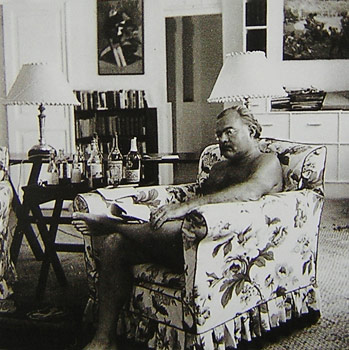
one of Hemingway's work spaces

I have always had a fascination for the spaces that authors use for their writing. The rooms, the desks, the tools and the things that surround them are interesting to see. I think it was the old Saturday Evening Post magazine that ran a regular page on writers' desks at one time. I suppose that when I was younger, I thought that some secrets about their writing must be hiding in those spaces.

Devers
I discovered at least one other person who is interested in this. A.N. Devers is the founder and editor of Writers' Houses, a website dedicated to exploring writers’ spaces and the literary pilgrimage.

She says that she created her site dedicated to documenting writers’ houses because of "a growing obsession, since childhood, with books, travel, and making connections between a writer’s work and place. It also came from a realization that there wasn’t a comprehensive resource online, or in print, that helped literary pilgrims find their way."

You can search on the site by author, city or state. In my own NJ, there were only two listed. One is the Walt Whitman house (which I have visited) and the other is the home of James Fenimore Cooper (which I have not seen).

I wouldn't call my trip to Whitman's home a "pilgrimage" though I suppose that's what these trips might be for some people. I went with my friend Steve and the docent guide mistakenly assumed we were gay because, according to him, the house is a kind of pilgrimage stop for gays.

I found a piece Devers wrote online about two literary home visits. First she describes a visit in Georgia to Flannery O'Connor's home.

This past August, I bought, for two dollars, a small plastic jar of dirt from the gift shop located inside Flannery O’Connor’s house in Milledgeville, Georgia. For the same price I also bought a jar of pond water. At some point, the dirt and pond water had been procured from the grounds of Andalusia, the O’Connor family’s 544-acre farm. On my way to the car after my tour, I picked up a small feather from a peafowl. The Andalusia Foundation recently acquired three peafowl: two peahens and a peacock, no doubt because their visitors were clamoring for them. The peafowl are not descendants of O’Connor’s original forty to fifty birds. Even though I knew this, I placed the feather on my car’s dashboard. Andalusia was the sixth of fourteen writers’ houses I visited on a ten-day road trip across the American South. At some point during the trip, the feather blew out of the car window. I regretted not being more careful with it.

Before I raided the gift shop, I stood behind a rope looking into Flannery’s first-floor bedroom, which was also her writing room. Her crutches were the first things I saw—they are the first things the visitor is meant to see. It is an evocative tableau: her desk and typewriter are situated close to the window, her crutches propped up against a wardrobe behind the desk. But unlike much of the decor in the house, the desk and the typewriter weren’t Flannery’s. I only know this because earlier that day I had seen the real artifacts down the highway a few miles in an exhibit room at her alma mater, Georgia College & State University. It didn’t matter much to me that the desk and typewriter weren’t authentic. Perhaps I didn’t care because I had already seen them. But more likely it’s because I’ve grown used to the reproduction furniture and other anachronisms of the houses of dead writers open to the public. I suppose in that way I am a sympathetic literary pilgrim.

So why visit the homes of the literary departed? She mentions some reasons: hope for proximity, epiphany, trivia and biographical data, an attempt to pull images from our memory of favorite novels, stories, and poems and match them to rooms and objects, to ask questions about the person and place and to separate fact from myth.

One author I would make the pilgrimage for is Ernest Hemingway. He offers several places to visit. His Key West home is the most popular writers’ house in America.

...the Ernest Hemingway Home and Museum in Key West, plays fast and loose with stories and anecdotes from Hemingway’s life. The house is a privately owned and operated business that has brilliantly capitalized on three things in the following order: people love cats, people love Ernest Hemingway, and Ernest Hemingway loved cats. The story goes like this: the scores of cats that have lived over the decades on the property in Key West are direct descendants of Hemingway’s original cats, including Snowball, a six-toed cat who was given to Hemingway as a gift from a sea captain. When I visited in 2008, the Key West guide showed off a picture of Hemingway’s young son Patrick, holding a snow-white kitten in the yard. But in a 1972 Los Angeles Times article by Charles Hillinger, Ernest Hemingway’s last wife and widow, Mary Hemingway, states, “Ernest…never kept animals at the Key West house during the last twenty years of his life. He never stayed at Key West long enough to bother with animals after his divorce from Pauline.” In a 1994 interview with the Miami Herald, Patrick Hemingway stated the cats in the picture were his neighbors’ who wrote in to the paper to confirm. The cat myth began with Bernice Dickson, who bought the Hemingway house in 1964 and opened the estate as a tourist attraction. At some point she started breeding and selling six-toed cats, even sending them through the mail, and claiming, “they are a special Asiatic breed that Mr. Hemingway had when he was here.”

EH reading in Cuba
Supposedly, Hemingway’s family had "sour grapes because they’d failed to keep the lucrative property." Hemingway wrote letter from abroad asking about the animals at Key West - but was referring to his peacocks (which Flannery O’Connor also owned - maybe I should get a few of those...)

I could also make the journey to his birthplace in Oak Park, IL.

When the Hemingway family left that house, they built a new family home at 600 North Kenilworth Avenue, where Ernest spent his high school years. (This second home, while owned by The Ernest Hemingway Foundation, is not yet open to the general public. Possible stop #4)


video of his birthplace in Oak Park, IL


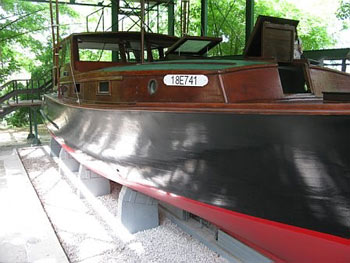
Papa's beloved Pilar


The third stop would be tougher to get to, but might be the most interesting. Hemingway loved his Havana home, La Finca Vigia, and would have stayed there till the end of his life if it wasn't for the political issues (and the big fish becoming harder to find in the Gulf). His beloved boat, Pilar, is kept there.


Thoreau's Journal


Most people know Henry David Thoreau for his book Walden. That story about two years he spent living by Walden Pond in the Concord woods is many a person's quiet armchair adventure. Seems like quite an ideal little respite from the world. The book is certainly his masterwork and a classic. But Thoreau also kept journals. In fact, he started at 20 and continued for 24 years, until 1861, shortly before he died.

The Journal of Henry David Thoreau 1837-1861, a one-volume edition of that journaling, was only published in 2009.

Henry David Thoreau’s Journal was his life’s work and at roughly seven thousand pages, or two million words, it is Thoreau’s least-known work. This new reader’s edition is the largest one-volume edition of his journals. (Yes, there is a a 14 Volumes set available too.)

I admire his daily practice of journal writing that accompanied his daily walks. Henry would have been an excellent blogger.

With spring now fully in my bloodstream, this is a good time to read some Thoreau, go for a walk, and get back to my own journaling.

“It is in vain to write on the seasons unless you have the seasons in you.” ~ Thoreau


420 Characters


Last month, the illustrator-turned-author Lou Beach released a book of extremely short stories titled 420 Characters - miniature stories that began as Facebook status updates and that are just 420 characters long.

On the program, Studio 360, Kurt Andersen challenged listeners to write their own 420-characters stories. You can read them all here.

Lou Beach judged the contest, and kicked in the prize — a signed print of one of his own illustrations.

I really like this runner-up entry:

I pace my side of the lake we swam all summer. Winter’s first blizzard has blocked all roads; the half-mile swim between us is now a walk across thin ice. I say I’ll cross when the ice is thick. You propose we meet now—halfway. And then? If the ice cracks on your side, you’ll jump to mine, you say. Where have you studied ice? Think how a window swallows a baseball. You really want to take a swing at that?
—Mary Soufi, Vacaville, California

The winning entry:

It was dog number four that put the nail in the coffin, so to speak. It was about a month after the café went out of business, less, maybe. He comes home with it in his arms. Big thing, but still in his arms, carrying it across the threshold. I think he was trying to be funny. But it wasn’t funny. He was never funny.
—Samantha Wilson, Melbourne, Australia


LOU BEACH is an award-winning illustrator and gallery artist, well known for his record covers and magazine work. A book of his artwork, Cut It Out was published in 2006.

To read excerpts from 420 CHARACTERS and to hear them being read by Jeff Bridges, Ian McShane and Dave Alvin, visit www.420characters.com.

I Write Like

I don't what the voodoo algorithms are behind the I Write Like website. You paste in a sample of your writing and it "analyzes" the style and tells you what writer you write like.

I took a blog post that was pretty good and pasted it in. Rudyard Kipling. I cut all but a few sentences and did it again. Dan Brown. Then I used the middle section. Margaret Atwood. Section 4 got me Leo Tolstoy. On the fifth try, I pulled out the paragraph I liked and got Ernest Hemingway. That's where I stopped.

No one will object to having their writing compared to a famous author.


I write like
Ernest Hemingway
I Write Like by Mémoires, Mac journal software. Analyze your writing!


Doing a bit of clicking on the site's blog turns up this explanation:

“Actually, the algorithm is not a rocket science, and you can find it on every computer today. It’s a Bayesian classifier, which is widely used to fight spam on the Internet.

Take for example the “Mark as spam” button in Gmail or Outlook. When you receive a message that you think is spam, you click this button, and the internal database gets trained to recognize future messages similar to this one as spam. This is basically how “I Write Like” works on my side: I feed it with “Frankenstein” and tell it, “This is Mary Shelley. Recognize works similar to this as Mary Shelley.” Of course, the algorithm is slightly different from the one used to detect spam, because it takes into account more stylistic features of the text, such as the number of words in sentences, the number of commas, semicolons, and whether the sentence is a direct speech or a quotation.”

Is their a lesson in style hiding in here? Or is it all just an interpretation of probability can be seen as an extension of logic that enables reasoning with uncertain statements? Probably...

Can You Write Like Sarah Palin?

Write Like Sarah Palin - A little challenge from Slate.com
What is the single worst sentence in Sarah Palin's Going Rogue: An American Life? According to Slate's Going Rogue index, it comes on Page 102:
"As the soles of my shoes hit the soft ground, I pushed past the tall cottonwood trees in a euphoric cadence, and meandered through willow branches that the moose munched on."
Michiko Kakutani of the New York Times didn't have to read past the first paragraph for her nomination:
"I breathed in an autumn bouquet that combined everything small-town America with rugged splashes of the Last Frontier."

Do you think you can write like Sarah Palin?

Write a sentence that could be mistaken for one from her book. A single sentence of fewer than 150 words.  Send your entry to writelikepalin@gmail.com by 11/25.


(Does it still count as an "Evening" in Paradelle if I'm typing at 3:41 AM but I still haven't gone to sleep? I'm thinking, Yes.)

Three Minute Fiction

NPR asked people to send in original works of fiction that could be read in three minutes or less. They got more than 5,000 submissions and asked literary critic James Wood of The New Yorker to pick the winners.

The big winner was Molly Reid with "Not That I Care"
and the five runners-up are:
more info

Updike and Cheever

Dick Cavett writes a blog for The New York Times. He blogged about when he had interviewed John Updike and John Cheever on the same show and that has led them to offer the complete version of that show from 1981.

Here is a link to the video

Quotes From Students


A few lines from this week's papers passed on to me by a colleague...

After you read the thirtieth essay, some of this starts to sound very wise. Then you get up, make some coffee, take a few sips and return to the papers and you realize that it's gibberish.

“Rome’s Empire fell and America’s has not, because Rome has suffered from their imagination and America is suffering from debt”
The professor suggested that one might prefer to fall with imagination, then succeed in debt.
It makes me think of Woody talking to Buzz Lightyear in Toy Story:

"That wasn't flying! That was... falling with style!"

Another from a student paper where the topic was the need for “discipline and laws.”
“If they was not to exist there would be chaos at a constant rate.”
What would Albert have thought about that?

And finally
“What may not surprise you is the fact that the football players, just like the gladiators, are expandable.”