Services

Showing posts with label Moby Dick. Show all posts

Herman Melville Sets Sail

 "A whale ship was my Yale College and my Harvard." - Herman Melville

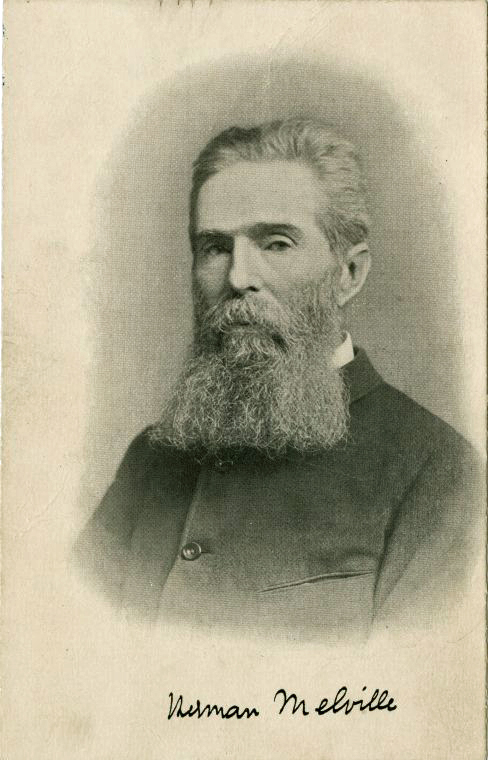
The last known image of Melville, 1885
The Writer's Almanac reminds me that on this day - January 2 - in 1841, Herman Melville set sail on the whaler Acushnet from New Bedford, Massachusetts.

Herman Melville was born into an affluent family that had fallen on hard financial times. Becoming a whaler was not on his life plan, but after the death of his father and a fire that wiped out his brother's business, Herman had to leave school to work.

A New Yorker, he tried a variety of things: a job at a bank, less than a month as a lowly merchant mariner (called a "boy") on a voyage to England and back, farming out West, teaching and then again to take to the sea.

In 1841, he went to the whaling port of New Bedford, Massachusetts. He had little experience at sea and no experience at whaling but he was taken on in a lower position on the new whaling ship Acushnet. It was a 359-ton ship with two decks and three masts. It was headed to the Pacific Ocean.

Whaling was lucrative for the owners who sold the prized oil for a high price, but also sold the teeth and bones.  Whale oil reigned supreme until 1859 when petroleum was discovered in Pennsylvania. The oil hat came from melting down whale blubber was fuel for household lamps, streetlights, and even lighthouses, and it was one of the most popular lubricants, used in factory machines, sewing machines, and clocks.

Melville would later write about whaling in Moby-Dick, or The Whale and made it sound accurately dangerous and adventurous. He would be in the last generation of men who hunted whales by hand using harpoons up close.

The sperm whale was the preferred target and they could weigh up to 60 tons and grow up to 60 feet long and swam at a speed of 20 knots. They were known to have killed men and destroyed ships during a hunt.

His first whale hunt was off the coast of Brazil in March of 1841. Melville ultimately spent four years at sea and much of his writing would come from that time. He would not have been at first one of the men in the smaller whaleboats that chased and harpooned a whale. But he would have observed that and seen a harpooned whale take the small boat for a "Nantucket sleigh ride" as they continued to harpoon and tire the whale until the dead whale could be towed to the ship. He would have been involved in the laborious and extremely messy process of skinning it on deck.

Melville and shipmate Richard Greene would desert the Acushnet in July 1842 in the Marquesas Islands. Greene would become "Toby" in Melville's first book, Typee. about their time there.

 Scrimshaw whaling scene carved by a Nantucket whaler, Edward Burdett.
Burdett was a deck officer who died at the age of 27 when a harpoon line
caught around his feet and dragged him overboard to drown in the ocean.

Though we know of his whaling days mostly from Moby-Dick, Melville also wrote about his years at sea in other books. Typee and Omoo were about his time in Polynesia after he had jumped ship. His fourth book, Redburn: His First Voyage, is about being a merchant mariner out of Liverpool, England. It is actually funny in parts and quite different from the heavier Mardi (1848). His time in the U.S. Navy is recounted in White-Jacket (his fifth book)

Though these five books established him as a writer, their sales were not great. The best-selling were the first two tales of the islands and sales dropped with each new book. His sixth book would be the novel is known for but that had poor sales and reviews when it was published.

Along with his own experiences at sea and whaling, Melville was inspired by a number of other books, both fiction and non-fiction. Richard Henry Dana Jr.'s new novel, Two Years Before the Mast and meeting William Henry Chase, the son of Owen Chase, who gave him a copy of his father's account of his adventures aboard the ship Essex and its encounter with a sperm whale are clear influences. An account published in 1839 in an issue of The Knickerbocker magazine of the hunt for a great white sperm whale named Mocha Dick not only influenced Melville to sign on to the Acushnet, but clearly figured into his own novel. Moby-Dick is a novel with inter-chapters that are largely non-fiction about whales and whaling.

The novel sold poorly and Melville would never again be well reviewed in his lifetime and forced to find work other than being a writer in order to pay the bills.

His real fame would come after his death. Though he had trouble publishing his writing after Moby-Dick, modern readers and critics would praise this later work, including stories such as Bartleby the Scrivener, Billy Budd and The Confidence Man. Today, Moby-Dick is considered a very ambitious and great novel though sadly Melville would never know that and never benefit from its continued sales and study.


Father Mapple, Captain Ahab and Orson Welles

Orson Welles played Father Mapple in John Huston's film version of Moby Dick. He gives the sermon on Jonah and the whale that Ishmael and his Christian shipmates hear before sailing. Welles would have made a great Ahab.


Welles planned to do something on his own with Melville's Moby Dick. He started and never finished filming some scenes in 1971.

The footage is Welles reading from the book, shot against a blue screen with some basic inserted footage that made it look like he was at sea.

At the time, he was actually filming The Other Side of the Wind, another more ambitious film that was also left unfinished.

It is unclear what Welles planned to do with the Moby Dick readings.

When Orson Welles died in 1985, all of his unfinished films were left to his long-term companion and mistress Oja Kodar. She turned many of them over to the Munich Film Museum for preservation and restoration. In 1999, the Munich Film Museum edited together the rushes of Moby Dick into a 22-minute cut, but we don't know what Welles planned to do with that footage - certainly not just him reading a book on film.

Bowhead Whales Carrying History

A bowhead whale spyhops off the coast of western Sea of Okhotsk - Photo by Olga Shpak
A bowhead whale is a dark-colored whale without a dorsal fin. It can grow 14 to 18 m (46 to 59 ft) in length and can weigh from 75 to 100 tonnes. The bowhead has the largest mouth of any animal, but is considered to be the Arctic's gentle giant.

They live entirely in Arctic and sub-Arctic waters, and do not migrate like other whales to low latitude waters to feed or reproduce. They are loners and are rarely seen in pods with other whales.

I read that in some mythologies whales were considered ancient wanderers who carried with them the history of the world. Bowhead whales are among the heaviest animals on Earth, second only to the blue whale.

The bowhead was also known as the Greenland right whale or Arctic whale and American whalemen called them the steeple-top, polar whale, or Russian whale.

Bowhead whales were killed in such large numbers by the American commercial whaling ships from 1848 to 1915 that only about 1000 of them remained. Thanks to protections for the endangered species, there are about 14,000 of the mammals in the Alaskan waters of the Arctic.

Bowhead whales have a huge skull and the name comes from the shape of the jaw, which resembles an archer’s bow. It can be more than 16 feet (5 m) long and makes up 30-40% of their total body length. They can use their skull to bust through thick ice. The Arctic waters are survivable because of their 17-19 inch (43-50 cm) thick blubber layer, which is the thickest of any whale species.

Instead of teeth, bowheads have about 350 large baleen plates that filter seawater allowing them to eat small animals, including zooplankton.

A recent discovery of a 200 year-old stone harpoon point in a whale confirms that some bowheads alive today may have been pursued by whale ships like the one that carried Herman Melville and could be older than the real-life whale that inspired him to write Moby Dick.

18th century engraving showing Dutch whalers hunting bowhead whales in the Arctic


More at www.smithsonianmag.com

It Was A Damp November in My Soul


A few rainy days had me feeling glum and achy. And I spent a few days in and out of doctors' offices seeking yet another white whale. And this recently past November seemed particularly like a damp one in my soul with all the election bad weather moving in.

I'm reading a book about Orson Welles. I became a big Welles fan when I discovered his films in my college days. I read a lot about him later and found that he was not a very nice person in real life. That happened with many of my heroes from the arts. It dulled the shine they had for me.

Net surfing last night I searched Moby Dick and Orson Welles and turned up a clip of Welles reading the opening of the novel. That is a section that always comes to mind this time of year. I love Welles' voice.

I'm reread Moby Dick just about every year and I find that I am not alone with that odd habit. I may watch the old film version of Moby Dick too. That version and the Classics Comic version were my first entry points to Herman Melville. I was surprised to find that the comic version is available in new editions (though at about 100 times the price I paid for the original comic book).

Call me Ishmael. Some years ago — never mind how long precisely — having little or no money in my purse, and nothing particular to interest me on shore, I thought I would sail about a little and see the watery part of the world. It is a way I have of driving off the spleen and regulating the circulation. Whenever I find myself growing grim about the mouth; whenever it is a damp, drizzly November in my soul; whenever I find myself involuntarily pausing before coffin warehouses, and bringing up the rear of every funeral I meet; and especially whenever my hypos get such an upper hand of me, that it requires a strong moral principle to prevent me from deliberately stepping into the street, and methodically knocking people’s hats off—then, I account it high time to get to sea as soon as I can. This is my substitute for pistol and ball. 

People have asked me "Is Moby Dick your favorite novel?" I don't like "best of" or "favorites" lists. I can tell you a bunch of novels I really like, but I won't rank them. Moby Dick is in that top group, but I know it's not a beloved book by the majority of readers. It's not easy. It feels very old. So what keeps me coming back to it?

I am not clear myself what it is about the book - or the whale - that keeps me coming back. Even Ishmael was unsure about what it was about the whale.

What the white whale was to Ahab, has been hinted; what, at times, he was to me, as yet remains unsaid...

Is it that by its indefiniteness it shadows forth the heartless voids and immensities of the universe, and thus stabs us from behind with the thought of annihilation, when beholding the white depths of the milky way?

And when we consider that other theory of the natural philosophers, that all other earthly hues — every stately or lovely emblazoning — the sweet tinges of sunset skies and woods; yea, and the gilded velvets of butterflies, and the butterfly cheeks of young girls; all these are but subtile deceits, not actually inherent in substances, but only laid on from without...


I wrote a short poem, "The Pequod and the Rachel," about one aspect of the story.

It was the Pequod that pursued Moby-Dick,
but in the end Melville wanted us
to remember that it was the Rachel,
searching again for her own missing children,
who came upon Ishmael – yet another orphan.

Do I feel orphaned these days? "Orphaned" is not a bad choice for how I feel. To stay in the watery world, "shipwrecked" might also be a good way to describe how I was feeling. Key word there: "was." It passed. Time has a way of doing that in most cases. Maybe reading some Melville helped. Maybe I needed a sunny, dry day and a good hot cup of tea.

Slowly crossing the deck from the scuttle, Ahab leaned over the side and watched how his shadow in the water sank and sank to his gaze, the more and the more that he strove to pierce the profundity. But the lovely aromas in that enchanted air did at last seem to dispel, for a moment, the cankerous thing in his soul... From beneath his slouched hat Ahab dropped a tear into the sea; nor did all the Pacific contain such wealth as that one wee drop.


RELATED (sort of)

Of Whales and Rocks

heart

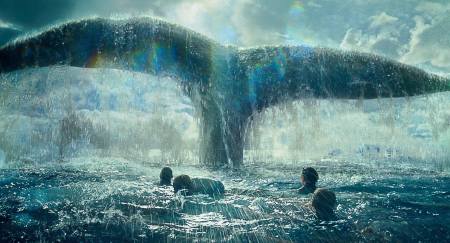
Nathaniel Philbrick's book In the Heart of the Sea about the whaleship Essex is now a movie by the same name. Directed by Ron Howard, it is not a retelling of Melville's Moby-Dick, as it is erroneously described sometimes, but the very different story of the real sinking of a ship by a large (and not albino white) sperm whale that inspired parts of Melville's novel.

In the Heart of the Sea is the story of the Essex which left Nantucket in 1819 for the South Pacific with twenty crew members aboard in search of whales. In the middle of the South Pacific the ship was rammed and sunk by an angry sperm whale.

The crew drifted for more than ninety days in three tiny whaleboats, succumbing to weather, hunger, disease, and ultimately turning to drastic measures in the fight for survival.

Philbrick has also written a version of the story for younger readers called Revenge of the Whale: The True Story of the Whaleship Essex.


Since Philbrick wrote Why Read Moby-Dick?, it is clear that he is a fellow admirer of Mr. Melville's novel. I reread that novel or at least parts of it, every year. It has become a kind of ritual when "I find myself growing grim about the mouth; whenever it is a damp, drizzly November in my soul; whenever I find myself involuntarily pausing before coffin warehouses, and bringing up the rear of every funeral I meet; and especially whenever my hypos get such an upper hand of me, that it requires a strong moral principle to prevent me from deliberately stepping into the street, and methodically knocking people's hats off." This might happen in winter or when I feel spring nearby and I feel it "high time to get to sea as soon as I can" - or at least set sail on the Pequod again, doomed as it may be.


Another book by Philbrick that I have read is Mayflower: A Story of Courage, Community, and War and I agree with him that The Rock is the a very disappointing piece of American tourism.

I saw that rock on a road trip I made back in 1971 and it was truly underwhelming. Now that I read the story behind that hunk of Dedham granodiorite glacial erratic, it makes more sense that I felt that way. That doesn't mean the rock is unimportant though.

It was pretty much legend from the start that said that the rock at the foot of Cole's Hill was the one where the Pilgrims landed in 1620. There were plans to build a wharf at the Pilgrim's landing site in 1741.

Thomas Faunce, 94 years old and the town record keeper, identified the rock that his father said was the first solid land the Pilgrims set foot upon.  Actually, the Pilgrims first landed near the site of modern Provincetown in November 1620 and then moved on to Plymouth.

That initial settlement was built on nearby Leyden Street leading up toward Burial Hill.

In 1774, they decided to move the rock and in transporting it in a wagon, it fell off and split into two.
They left the bottom half behind at the wharf and relocated the top to the town's meeting-house.

Over the years, they built a structure to house Plymouth Rock (well, part of it) and eventually added a gate to stop souvenir hunters who had been hacking off parts of it. The upper portion of the rock was also brought back to the wharf and the date "1620" was carved into the rock.

P_09 Plymouth - Plymouth Rock's Canopy


In 1920, the rock was relocated again and the waterfront rebuilt with a waterfront promenade behind a low seawall, in such a way that when the rock was returned to its original site, it would be at water level so that you could see the tide-washed rock.

Parts of the Rock were taken, bought and sold over the years, and about one-third of the top portion remains. Today there are pieces in Pilgrim Hall Museum as well as in the Patent Building in the Smithsonian.

Alexis De Tocqueville, a Frenchman traveling throughout the United States, wrote in 1835:
"This Rock has become an object of veneration in the United States. I have seen bits of it carefully preserved in several towns in the Union. Does this sufficiently show that all human power and greatness is in the soul of man? Here is a stone which the feet of a few outcasts pressed for an instant; and the stone becomes famous; it is treasured by a great nation; its very dust is shared as a relic."
I find myself reading more non-fiction these days than ever before and Philbrick's book is also good about describing what that first Thanksgiving was really like and why the Pilgrims never called themselves pilgrims.

Napoleon Bonaparte said that “History is a set of lies agreed upon.” I agree.


The Whale


THE whale is the sperm whale. The Moby Dick whale.

But the leviathan of this post is The Whale: In Search of the Giants of the Sea, a book by Philip Hoare.

Hoare goes to Nantucket, a Melville place, and checks in with Poe, Hawthorne and Thoreau. He consults the writing of Thomas Beale, the foremost authority on whales in the early 19th century. Beale influenced others - even the whaling paintings of Turner derive which inspired Melville who was new to writing.

Hoare finds whale information like Melville found and wrote about in those Moby Dick inter-chapters:

During World War II, whales were bombed from above because they were misidentified as enemy submarines. They were also hunted by Allied and Axis ships alike for meat and oil.

When John F. Kennedy was buried, in his coffin was a whale tooth. It was an intended Christmas gift, placed there by his wife. Hoare writes: "It was a potent act, the king of Camelot interred with the talisman of a heroic age."

The book is described as "part memoir, part nature writing and part literary criticism, the book takes readers around the world for an exhaustive look at the mysterious mammal."

Amazon.com Review
After reading Moby Dick, author Phillip Hoare was so captivated by the subject that he spent years trying to fathom the planet’s most enormous and enigmatic of creatures. Hoare's admitted mania for whales led him to write Leviathan, or the Whale—which was awarded the 2009 Samuel Johnson Prize, Britain’s most prestigious award for nonfiction. The book has finally migrated to this side of the Atlantic under a new title, The Whale. Hoare is not a scientist, but rather a biographer whose subjects have tended toward highbrow figures like Noel Coward and Oscar Wilde. In approaching cetaceans, the author’s non-scientific background works to great advantage. Similar to Melville, Hoare has captured a wide range of historical and scientific facts about whales, but has chosen to present them through an extremely powerful instrument--the literary imagination. The result is a deeply moving and thought-provoking biography of the planet’s toughest, yet most vulnerable of prehistoric survivors. The Whale takes us well beyond the limits of what we can see, hear or otherwise objectively "know" about whales, and offers a much more vivid sense of their true magnitude. --Lauren Nemroff


A "trailer" by Phillip Hoare about the search for Moby Dick.


Moby-Dick: or, The Whale(Penguin Classics Deluxe Edition)

Moby Dick