Leonardo da Vinci understood geology based on physical evidence he found. His studies of
rocks, fossils, and river erosion led him
to the conclusion that the world is far
older than stated in the book of Genesis,
and he argued that marine fossils found
in the mountains were the result of
falling sea levels, not the Great Flood. He wrote:
And a little beyond the sandstone conglomerate, a tufa has been formed, where it turned towards Castel Florentino; farther on, the mud was deposited in which the shells lived, and which rose in layers according to the levels at which the turbid Arno flowed into that sea. And from time to time the bottom of the sea was raised, depositing these shells in layers, as may be seen in the cutting at Colle Gonzoli, laid open by the Arno which is wearing away the base of it; in which cutting the said layers of shells are very plainly to be seen in clay of a bluish colour, and various marine objects are found there.
A page of Leonardo's Paris Manuscript I is covered in sketches of marine fossils.
Among them is a honeycomb-like array of hexagons that palaeontologists think might constitute the first recorded observation of an enigmatic trace fossil called Paleodictyon.
He recognized fossils as petrified remains of former living organisms and even applied paleoecological principles to reconstruct the deposition of sedimentary rocks. Of course, he never published his notebooks and his theories were not well known during and for many years after his death.
Later, Nicolas Steno (1638-1686), with his stratigraphic principles, Robert Hooke (1635-1703), with his paleontological interpretation of fossils, and finally James Hutton (1726-1797), with his earth-theory, would make discoveries and theories that would have an impact on scientific thinking.
I have had a long interest that is more historical than religious about the life of Jesus of Nazareth. I heard Reza Aslan interviewed about his book Zealot: The Life and Times of Jesus of Nazareth and I knew it was a story I'd want to read.
Aslan first did a bachelor’s degree is in religious studies with a minor was in biblical Greek. He then did graduate work at Harvard University in world religions, and a Ph.D. from UC Santa Barbara in the sociology of religions. He also has an MFA from the University of Iowa.
In this story from 2000 years ago, we follow an itinerant Jewish preacher and miracle worker who walked across Galilee and gathered around him followers to establish what he called the “Kingdom of God.”
He is a revolutionary. His movement threatened the established order. Like others of his time, he was captured, tortured, and executed as a state criminal.
What first caught my interest in Aslan's interview was that his disillusionment with the Bible stories grew as he studied them because of the inconsistencies of the stories told in the gospels, both those we know "officially" and others including the gnostic gospels.
The book puts Jesus back into his era. This first-century Palestine was filled with many Jewish prophets, preachers, would-be messiahs, miracle workers and magicians. It was the age of zealotry, which was a fervent nationalism that made resistance to the Roman occupation a sacred duty incumbent on all Jews.
The entire story is filled with contradictions. Jesus was a man of peace who told his followers to arm themselves with swords. He gave public displays of exorcisms and healings, but told his disciples to keep his identity a secret.
But the early Christian church portrayed Jesus as a peaceful spiritual teacher rather than a politically conscious revolutionary.
In another book, No god but God, Reza Aslan explains Islam. That is a topic that is also ancient but certainly is highly topical now.
My reading of his books and further online searching led me to discover stories of "Jesus’s Wife." Though it sounds like a chapter from The Da Vinci Code, Aslan also discusses in Zealot the women who followed Jesus.
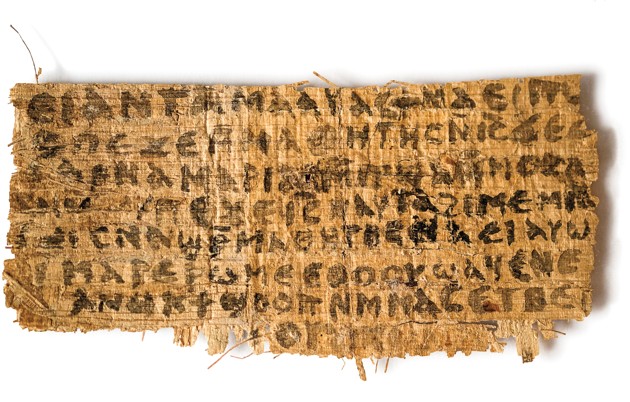
Was Jesus Christ married to one of them? A scrap of manuscript suggests that he had a wife.
“The Gospel of Jesus’s Wife” papyrus (Karen L. King / Harvard / AP)
It is a 1300-year-old scrap of papyrus that has the phrase “Jesus said to them, My wife.” It is written in the ancient language of Coptic.
When the Harvard historian of early Christianity, Karen L. King, presented the papyrus in 2012 at a conference in Rome, it caused a lot of interest and controversy. And the controversey seems to still be ongoing.
No manuscripts before had mentioned Jesus being married. The scrap of writing suggested that the complete manuscript might describe a dialogue between Jesus and the apostles over whether his “wife” was “worthy” of also being a disciple.
Was that woman Mary Magdalene? Aslan says that for a Jewish man of that time not to be married when he was in his thiries would have been very unusual. Jesus’ marriage would have been arranged by his parents, probably between his 16th and 30th birthdays. In rabbinic literature the age of twenty is given as the upper limit of marriage, and it was especially important for aspiring teachers and religious leaders.
portion of da Vinci's Last Supper
In The Da Vinci Code book and movie,the suggestion that sets the book in motion is that da Vinci painted the truth and showed Jesus next to his wife, Mary Magdalene. A character in the book says "The individual had flowing red hair, delicate folded hands, and the hint of a bosom. It was, without a doubt … female." Art historians have pointed out that da Vinci had painted other masculine biblical characters with a feminine appearance. In Saint John the Baptist , St. John the Baptist, who was described in writings as quite masculine in appearance, is painted quite feminine with long flowing hair and delicate hands. So, is that Mary Magdalene at the right hand of Jesus, or a feminized John the Apostle? Obviously, da Vinci was not a witness to any "last supper" and if he did insert Mary, then where is the twelfth apostle that was described as being there? “And when the hour had come, He sat down, and the twelve apostles with Him.” (Luke 22:14)
Aslan doesn't really say that Jesus was married. Of course, many Christians refute Aslan's other claims. I saw articles online that claim his book is a Muslim view of Jesus. Conservative Christians also hated the recent Noah film for inserting what they saw as a a message about climate change. They were outraged by Martin Scorsese depicting Jesus as having sexual fantasies about Mary Magdalene in 1988’s The Last Temptation of Christ.
To humanize Jesus is to take him away from being a messiah or son of God. If, as Aslan posits, Jesus was married, was not a "virgin birth," that he was a Zealot who did not want to start a religion and that Jesus did not conceive of himself as partly divine - then we have some problems with the religions that believe those things to all be true.
"This is to be a collection without order, drawn from many papers, which I have copied here, hoping to arrange them later each in its place, according to the subjects of which they treat."
That is how Leonardo da Vinci (1452-1519) in 1508 described the sketches, notes, treatises and drawings that he began collecting while at the house of Piero di Braccio Martelli in Florence.
The Leonardo Notebook now in the British Library is in Italian and written in Leonardo's famously characteristic "mirror writing" that is left-handed and moving from right to left. His mirror-image cursive was originally thought to be for secrecy, but may have been more practical since he wrotewith his left hand, it was probably easier for him to write from right to left.
It wasn't originally a bound notebook. That was done after Leonardo's death and the loose papers were of various types and sizes and came from different periods in his life.
You can flip through digital copies of 29 pages known as the Codex Arundel at www.bl.uk
There isn't really one Leonardo Notebook, since the loose papers distributed by friends after his death have found their way into the collections of the Royal Library at Windsor Castle, the Louvre, the Biblioteca Nacional de España, the Victoria and Albert Museum, the Biblioteca Ambrosiana in Milan (which holds the twelve-volume Codex Atlanticus) and British Library in London.
The Codex Leicester is the only major scientific work of Leonardo in private hands. It is owned by Bill Gates and is displayed once a year in different cities around the world.