These books have been, and still are being, digitized under a digital education project called “Hermetically Open.”
A donation from author Dan Brown - who certainly has an interest in these areas and has used them to great advantage in his own novels - has enabled much of this work to be done.
Amsterdam’s Ritman Library has a sizable collection of pre-1900 books on occult subjects. Currently, the first 1,617 books from the Ritman project have come available in their online reading room.
If you are interested in having full access to hundreds of rare occult texts, you might want to check it out.
One caveat: these books are written in several different European languages, especially Latin, the scholarly language of Europe throughout the Medieval and Early Modern periods.
Other books appear in German, Dutch, and French.
This makes me want a Babel fish. The Babel fish is small, yellow, leech-like creature that feeds on human brain wave energy. After absorbing all unconscious frequencies, it can then "excrete" telepathically a matrix formed from the conscious frequencies and nerve signals picked up from the speech centres of the brain.
That means the babel fish when stuck in your ear allows you to instantly understand anything said to you in any form of language.
It would be amazing if we had this universal translator that neatly crosses the language divide between any species.
Adams says that the Babel fish could not possibly have developed naturally, and therefore it both proves and disproves the existence of God.
"I refuse to prove that I exist," says God, "for proof denies faith, and without faith I am nothing."
"But," says Man, "the Babel fish is a dead giveaway, isn't it? It could not have evolved by chance. It proves you exist, and so therefore, by your own arguments, you don't. QED."
"Oh dear," says God, "I hadn't thought of that," and promptly vanishes in a puff of logic.
"Oh, that was easy," says Man.
Is there the secret, the answer, to what we have been seeking in those texts? Maybe this is more than just the stuff of novels and movies.
I have had a long interest that is more historical than religious about the life of Jesus of Nazareth. I heard Reza Aslan interviewed about his book Zealot: The Life and Times of Jesus of Nazareth and I knew it was a story I'd want to read.
Aslan first did a bachelor’s degree is in religious studies with a minor was in biblical Greek. He then did graduate work at Harvard University in world religions, and a Ph.D. from UC Santa Barbara in the sociology of religions. He also has an MFA from the University of Iowa.
In this story from 2000 years ago, we follow an itinerant Jewish preacher and miracle worker who walked across Galilee and gathered around him followers to establish what he called the “Kingdom of God.”
He is a revolutionary. His movement threatened the established order. Like others of his time, he was captured, tortured, and executed as a state criminal.
What first caught my interest in Aslan's interview was that his disillusionment with the Bible stories grew as he studied them because of the inconsistencies of the stories told in the gospels, both those we know "officially" and others including the gnostic gospels.
The book puts Jesus back into his era. This first-century Palestine was filled with many Jewish prophets, preachers, would-be messiahs, miracle workers and magicians. It was the age of zealotry, which was a fervent nationalism that made resistance to the Roman occupation a sacred duty incumbent on all Jews.
The entire story is filled with contradictions. Jesus was a man of peace who told his followers to arm themselves with swords. He gave public displays of exorcisms and healings, but told his disciples to keep his identity a secret.
But the early Christian church portrayed Jesus as a peaceful spiritual teacher rather than a politically conscious revolutionary.
In another book, No god but God, Reza Aslan explains Islam. That is a topic that is also ancient but certainly is highly topical now.
My reading of his books and further online searching led me to discover stories of "Jesus’s Wife." Though it sounds like a chapter from The Da Vinci Code, Aslan also discusses in Zealot the women who followed Jesus.
Was Jesus Christ married to one of them? A scrap of manuscript suggests that he had a wife.
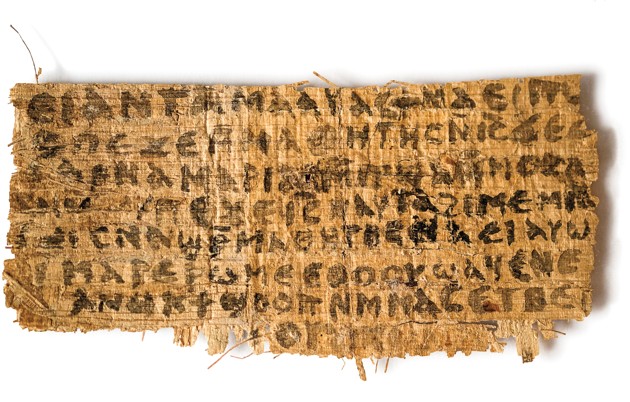
“The Gospel of Jesus’s Wife” papyrus (Karen L. King / Harvard / AP)
It is a 1300-year-old scrap of papyrus that has the phrase “Jesus said to them, My wife.” It is written in the ancient language of Coptic.
When the Harvard historian of early Christianity, Karen L. King, presented the papyrus in 2012 at a conference in Rome, it caused a lot of interest and controversy. And the controversey seems to still be ongoing.
No manuscripts before had mentioned Jesus being married. The scrap of writing suggested that the complete manuscript might describe a dialogue between Jesus and the apostles over whether his “wife” was “worthy” of also being a disciple.
Was that woman Mary Magdalene? Aslan says that for a Jewish man of that time not to be married when he was in his thiries would have been very unusual. Jesus’ marriage would have been arranged by his parents, probably between his 16th and 30th birthdays. In rabbinic literature the age of twenty is given as the upper limit of marriage, and it was especially important for aspiring teachers and religious leaders.
portion of da Vinci's Last Supper
In The Da Vinci Code book and movie,the suggestion that sets the book in motion is that da Vinci painted the truth and showed Jesus next to his wife, Mary Magdalene. A character in the book says "The individual had flowing red hair, delicate folded hands, and the hint of a bosom. It was, without a doubt … female." Art historians have pointed out that da Vinci had painted other masculine biblical characters with a feminine appearance. In Saint John the Baptist , St. John the Baptist, who was described in writings as quite masculine in appearance, is painted quite feminine with long flowing hair and delicate hands. So, is that Mary Magdalene at the right hand of Jesus, or a feminized John the Apostle? Obviously, da Vinci was not a witness to any "last supper" and if he did insert Mary, then where is the twelfth apostle that was described as being there? “And when the hour had come, He sat down, and the twelve apostles with Him.” (Luke 22:14)
Aslan doesn't really say that Jesus was married. Of course, many Christians refute Aslan's other claims. I saw articles online that claim his book is a Muslim view of Jesus. Conservative Christians also hated the recent Noah film for inserting what they saw as a a message about climate change. They were outraged by Martin Scorsese depicting Jesus as having sexual fantasies about Mary Magdalene in 1988’s The Last Temptation of Christ.
To humanize Jesus is to take him away from being a messiah or son of God. If, as Aslan posits, Jesus was married, was not a "virgin birth," that he was a Zealot who did not want to start a religion and that Jesus did not conceive of himself as partly divine - then we have some problems with the religions that believe those things to all be true.
“…human consciousness, as Noetic author Lynne McTaggart described it, was a substance outside the confines of the body. A highly ordered energy capable of changing the physical world. Katherine (Solomon) had been fascinated by McTaggart’s book ‘The Intention Experiment’, and her global, Web-based study – theintentionexperiment.com - aimed at discovering how human intention could affect the world.”
Anyone can learn to do effective intention in their life, but it does require some learned techniques.
To find out how to ‘do intention’, Lynne McTaggart interviewed many intention masters – Qigong masters, Buddhist monks, master healers – as well as scientists.
She extrapolated this program from the common practices of all these diverse healers, plus scientific evidence describing circumstances that created the most positive results in mind-over-matter laboratory experiences.
From this research she offers a blueprint for using intention effectively in your own life through a program she calls Powering Up.
Oh yeah, it's controversial. Religious groups are opposed to people praying without Praying.
I'm just saying - there's a Dan Brown effect.
Of course, if you want to make me your Intention of the Week, I could use the good karma, vibrations or whatever goodness comes my way.




 -
-  and sales on it have risen steadily since his book's release.